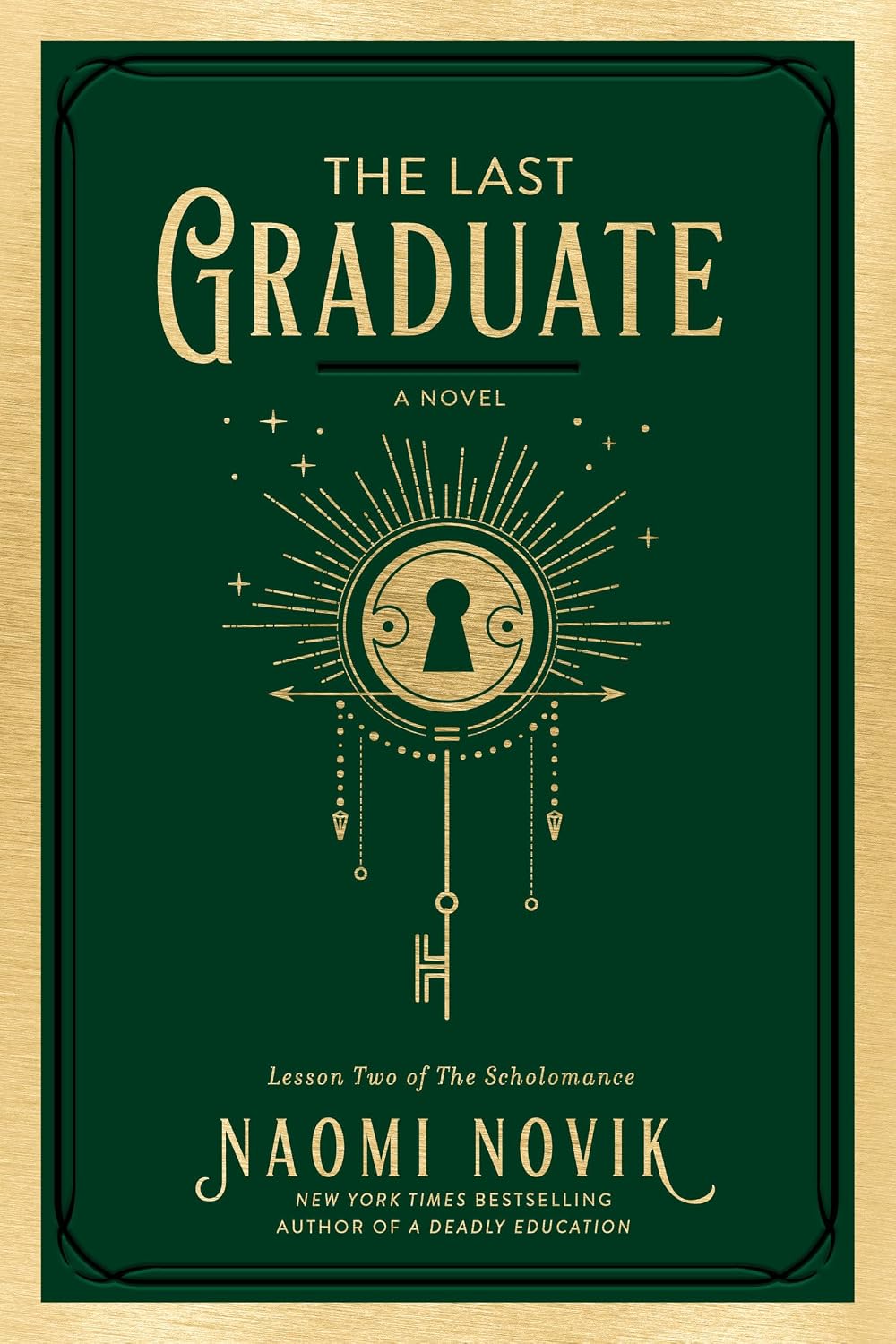
The Last Graduate by Naomi Novik
I did this to myself.
I was talking books with friends, recommended the Scholomance Trilogy to someone. Then went home, pulled my copy of A Deadly Education down from my shelves – ignoring the books I was already reading – and got right back into it. Which led, swiftly and predictably, to my needing to get the next book in the series.
It was still excellent. The second book both a very different experience from the first while also being absolutely compelling. I adore El as a character and her voice absolutely jumps off the page at you.
I don’t actually, have any comments to make as to how this book was crafted, I think I just want to share my thoughts on the story and the characters, to live in it just a little longer.
Romance Done Right
I complained previously about writers who try to time jump their romances. Well here is the counter example. Because we don’t get a lot of time seeing El and Orion together. We don’t see them having deep conversations and just hanging out the two of them. But when she does finally bring them together, you can see that these experience have happened. They show an understanding of each other that could only have come from that kind of intimacy. Referencing conversations that we haven’t seen happen.
He says (about his parents) “You can be mad at them if you want to be…” we know she blames his parents for his warped personal identity, but in this statement he shows he knows that too.
Similarly (and in the same conversation) she says “I’ve seen creepy, Lake; I’ve been inside creepy; and you’re nothing like.” This is in reference to the Maw-mouth, which he seems to know, even though at the time she she refused to tell him.
And did anyone else noticed how the ending in this one mirrors the ending of the first. With El and Orion in mortal danger and he tries to kiss her goodbye? This time she merely threatens to knee him. And he is the one who “saves” her (I’m not 100% certain if she needed to be saved here). I cant imagine he is going to stay dead for the last book, but I also cant guess at how he might survive and what it would mean if he did. He may well be more powerful than her. And she’s terrifying when you see her power compared to others.
Delayed Gratification – Enclave Building
There are, I think, also a lot of things that feel like set-ups that havn’t been payed off yet. And I cant help wondering if the school was doing more than simply walking her towards the goal of “fixing” it. It almost feels to me like it wants her to go out and build golden enclaves. Like maybe her getting the book was accidental, but from then on a lot of stuff has felt purposeful. It gave her a full class period with nothing to do but work on the book and encouraged her scholarship with academic merits (little though she valued them).
It gave her things, knowledge, that will make a difference in building these enclaves of hers. Aadyah gets the planter for her final project, but in such a way that El has to learn the manufacture of in detail herself. Individually all of these things can be explained away and El has an explanation for each one, but I wonder.
And I wonder if the golden enclaves haven’t happened because there just hasn’t been a mage of sufficient power, who would have an appetite for building them again. When the school realised it had found someone like that it dropped the book back into the world.
The bibliophile in me does hope destroying the school wont destroy the library and its holdings. I suppose not as I suspect the books are actually being drawn out of the void. Maybe next book we will get more insight into what that actually is.
Why a Scholomance?
Really, only a Victorian would believe that building a prison was the solution to wizarding education and survival. I do wonder what the lack of a Scholomance will mean for independent wizard kids. Will they get the education, the access to new spells and practise fighting mals they need for adult survival, if all they have is what their parents know or can collect? Does destroying the school improve equality or exasperate it?
And I am still struggling to understand why enclave kids needed to go to the Scholomance at all. The inside of an enclave is safe. That is the point of the thing. Even Orion comments that nothing much gets into the New York enclave. So maybe the problem isn’t while they are inside the enclave, but that it is too dangerous for them to go outside. Like the story of Aadyah’s sister. But again, why is the solution for that putting them in a prison for 4 years? And the answer I keep banging into is that it isnt about their safety. It is about a population of adults who dont want to police and fight with head strong teenagers who are not allowed outside their own homes. It is about removing the most attractive people from the enclave so that more dangerous mals, that might endanger the rest of the community, are not attracted to it. Far easier to send the children away. And once one generation has had to suffer it, they normalise the experience.
El thinks of enclave kids as spoiled, but what I dont think she is seeing is the pressure they are under to maintain their family’s position. Too many of them are working too hard at school. They are not sitting on their laurels. No, I’m seeing people who are spoiled in a lot of ways, but are also aware that if they cant keep themselves and their families relevant and valuable they could very well find themselves locked out. Just a feeling.
Themes – Greater good
In trying to understand the theme of the book, I struggled a little. The thing that seemed to come up repeatedly was cooperation and working together for a greater good. Creating a circle to heal Cora’s arm, working out new strategies for the graduation runs. The Scholomance locking seniors out of the cafeteria, until they did nice things for the younger students. Alfie and the London enclavers forming a circle and missing their turn to go home in order to keep the way open for other students.
Only problem is, if that is the theme is hasn’t paid off yet. That cooperative attitude didn’t lead, wasn’t the clincher that, caused the ending. Or, I don’t know, all the seniors do work together for the ending, but there wasn’t like an ah ha moment. It just doesn’t feel resolved yet, I dont feel like people took in that message. Just that they were starting to become comfortable with it. Maybe it’s that I can just see it as something that comes together in the last book.
Almost makes me wonder if the lesson wasn’t being learned for situations that will come after the Scholomance. Because this kind of cooperative thinking could become essential in building golden enclaves, especially without Orion to provide the raw power needed for them.
The Moral
The win in this story isnt through overcoming the odds, or rising to potential but about changing the game. About a group of young people who had the courage to change the status quo. That’s a pretty incredible lesson to take away in today’s world. Although in Novik’s genius, they havn’t won yet, because their solution still needs to get tested in the outside world, which I imagine will be then next book.
Characters
What else is there to say? I loved this book. I love El. I can really really relate to this character. That line about
having that scream locked inside me since I was 9
I feel that in my bones. The author has really caught the hurt and defensiveness that comes out of social ostracisation . And in the character of Orion, the hollowness of emotional negligence. And the way she expresses that on the page, through El’s perspective and with how little dialogue Orion gets is formidable.
We really get to see El growing in this book. Coming into the changes that started in the previous book with her establishing a community of her own. The emotional security that offers her. But also developing in new ways. Being able, finally, to decide what kind of magician, what kind of person she wants to be. Wanting to be a hero, not for adulation, or to prove the prophesy wrong. But because it is the right thing to do, because she has the capacity to help others.
I love how developed all the characters are. Consider Lui, the way she reveals her motivation, her decision that she wont be pushed into doing the ‘smart’ thing once she gets home and how that resonates with decisions she makes earlier in the story. Not going back to using malia, cutting her hair. All of these were acts of defiance.
I did wonder in thinking about her, whether her family chose that direction for her purely on pragmatic considerations, because her talent made her uniquely able to draw Malia in a “safe” way. Or if someone looked at this and decided that the lives of the two boys were more important that the one daughter’s future. We don’t have the info to tell, and Im totally drawing on a cultural stereotype here. But it was a hell of a thing to order your kid to do.
Adult or juvenile
Technically this is a young adult book, the characters are teenagers and it’s set in a school. And it certainly carries a lot of the tropes for one. But I cant help feeling that this really isn’t. It’s an adult book set in that world. The themes, the lessons, the observations of people are not those of a teen. And I really don’t feel that, had I read this as an eighteen year old, I would have understood it the way I do now. I think in setting it in this guise, the author challenges our perception of the world more sharply.
Im sure I could go on indefinitely. And Im not going to try laying predictions for the third book out, you can see where my mind is going. Im just going to finish up by saying that I think everybody should read this book. Anyone who has felt socially isolated, full of anger at the injustices of the world, and tired of the ways it seems unfixable will find something to love in this trilogy.
Also I am taking a bit of a break before attacking the third book.