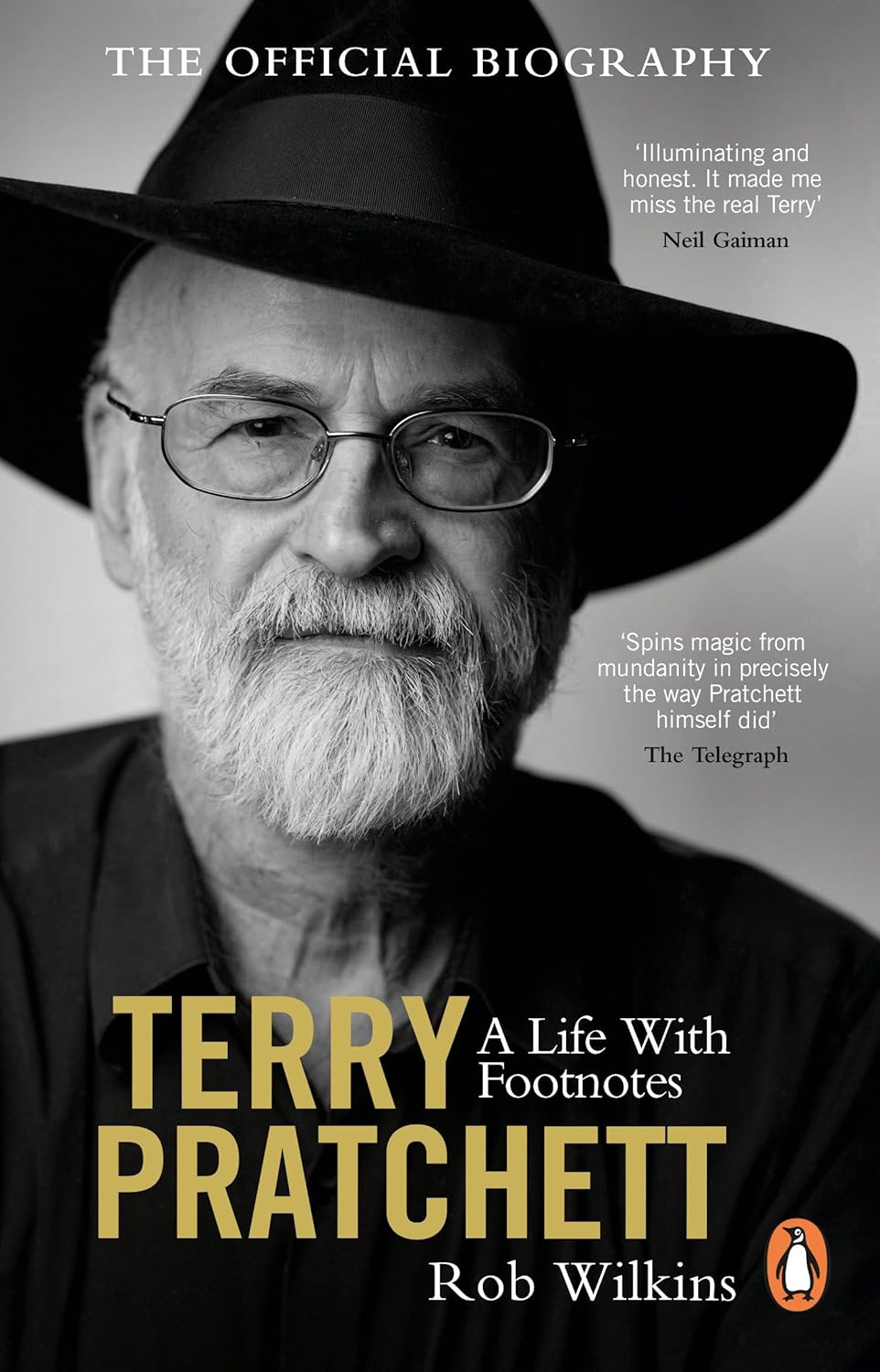
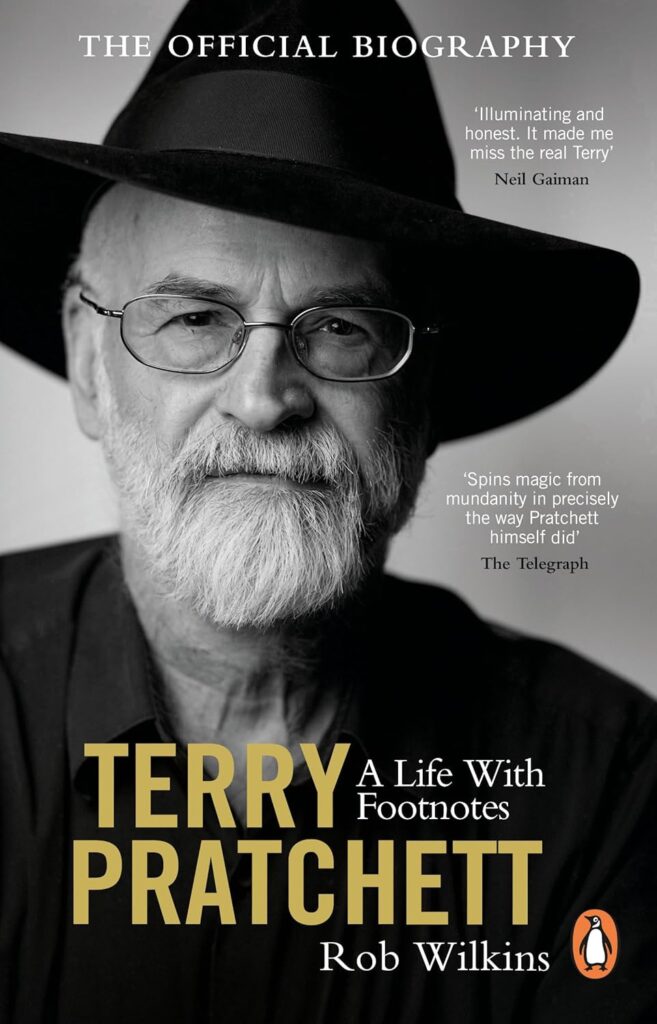
Terry Pratchett: A life with Footnotes by Rob Wilkins
I am, like a vast number of fantasy readers a big fan of the Discworld novels. They are as a rule, perceptive, cutting, and laugh out loud funny. Pratchett had a talent for both seeing the absurdities in the world and for reflecting the thoughts and beliefs (good and bad) of normal people. Who hasn’t wished that a real Lord Vetinary actually existed, instead of the political incompetents we pretend to be satisfied with? I will say though, that the books could be overly convinced of their own cleverness, while lacking in narrative drive or structure, but then, that wasn’t what I was reading them for. Discworld is always reliably good fun.
Pratchett’s illness and early death were a tragedy – I have a friend who was so devastated by the loss that to this day she has not been able to bring herself to read his last book (which incidentally also killed her favourite character). I thus came to this book with considerable curiosity. And, it was well worth it. This book wasn’t written as an auto-biography, although Pratchett himself started it. It was written and finished by his friend Rob Wilkins. Wilkins, who was also the narrator of the audiobook, worked for many years as Pratchett’s secretary (mostly a live dictation instrument and mischief assistant). It gives the book a personal perspective I think it might otherwise have lacked. Indeed, in many ways this book feels more like an account of a friendship than an analysis of a life. And just like when you are talking to real people, you can see both the surface meaning of their words and beneath that perspective is another view of the same person.
Writers Life
Before I get into Pratchett as a person, I want to address his author life. If you are reading this book to learn about becoming an author, than this is probably not going to be a big help for you, because Pratchett himself didn’t really know where his skills came from. Writing his books came naturally to him (mostly) and even when persuaded to teach he usually had no idea what to tell people. I did take a couple ‘crafty’ things away from this book. For example, the 5 years it took him to complete his second book (any how it never became the be-all of his life), I found that reassuring given how slowly I work. And then his often repeated mantra that
the first draft exists merely to tell yourself the story
Sir Terry Pratchett
This is so true of my own writing (whether I’m making these reviews or writing a story). I don’t know what I want to say, what I’m trying to say, until I have vomited all my thought higgledy-piggledy onto the page. The other thing I want to draw attention to is that this is another author who’s success was in no small way supported – even empowered by – the loving wife and family running his life around him, so he could goof around with words and electronics. It doesn’t say that in the book, it’s my interpretation, but I can feel the unseen hands holding things up. It is also interesting that Pratchett’s wife gets very little mention in the book, this may have been by her choice, but I do think it a pity.
A Man or a Demigod?
So who is Pratchett? Well if you take the book at face value, he was a brilliant, family man with a vivid imagination and (according to Gaimen) a deep-rooted anger at the world. His family and friends loved him dearly. He prioritised and valued his fans, which Wilkins attributes to the derision shown to fantasy readers by the literary class. He passionately loved his work and the way it brought him into contact with both educated and creative people. He was loyal to those friends and generous in wanting to work with others. He worked tirelessly in his later years campaigning for better treatment and care for Alzheimer’s patients and to raise awareness of, and reduce the stigma, of Assisted Dying, including filming a few documentaries on the subjects. The filming of which were often, intrusive, stressful and (in Wilkins’ view) undignified. He has probably done more for these subjects singly than anyone else, all without throwing his money around.
But I can also see in Wilkins’ accounts of Pratchett’s actions and motivations a bit of an egotist. Pratchett often wanted and strived for goals, not for their own intrinsic value but because others had them. He wanted a secretary after listening to another famous author boast about hers. He wanted awards, not because he valued the awards (or the institutions involved) or because he needed the validation, but to lord it over others. He wanted his books turned into films because Gaimen’s books had been, and so on. A competitive man. Also one who did not take criticism well. When his editor came back to ask for further work to be done on a novel that had already been submitted. He grumbled and moaned. Procrastinated on it for many hours, leaving Wilkins to wallow in anxiety and hang around for endless hours waiting for the great man to decide how he wanted to fix the editor’s critique. Wilkins eventually gives up at midnight and goes home and Pratchett punches something out in the dead hours of the night for Wilkins to submit in the morning. Wilkins attributes Pratchett’s behaviour to his being on holiday mode. Another explanation could be that he needed the time to work out a satisfying solution. But those of us who have worked with man-child bosses recognise a sulk when we see one.
I don’t say all this to put anyone off Pratchett. I will continue to read and love his books. But it is nice to see behind the larger-than-life figure. To see that he was also a difficult and interesting man. A human being, with many strengths and shortcomings. One who did many good things, but who could also be a real brat. I find that comforting to know. People don’t belong on pedestals because nobody is perfect.