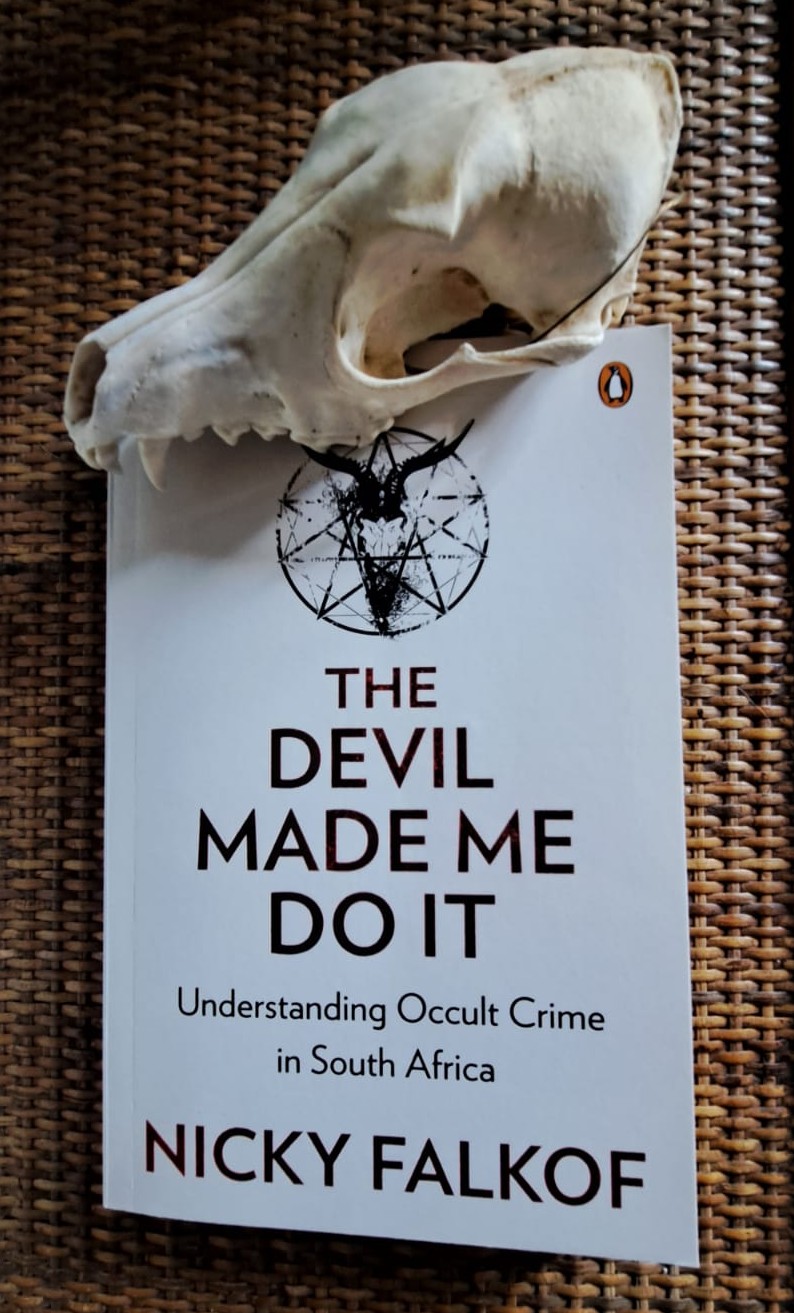
The Devil Made me Do it by Nicky Falkof
This book is an exploration of the Satanic Panic in South Africa. Tracing the development of this phenomenon from its height in the 80-90s, to how “occult crimes” are perceived in South Africa today. Exploring why the ideas of the Satanic Panic gripped this country so strongly, and why it seems to have stuck with us even as the panic has died away in other places.
Origins Story
I think I will start with how the topic came to interest the author and myself (enough to buy the book), then touch on some of the murders she analyses before we dig into the themes, since that is where the meat of the story is.
It started out as a academic work, but Falkof does a wonderful job of translating that research into engaging content that offers a mix of true crime, socio-political commentary and psychological exploration.
So Falkof and I shared certain similar experiences in that we were both goth kids in our teenage years. Meaning we both rubbed against the Satanic Panic. Which was very much about the idea that deviant children – being youngsters who would not conform to societal norms – were in danger of being morally corrupted and would then go on to perform all manner of evil actions.
For me growing up in the 2000s, after the main wave, it was experiences like Magic (the gathering) Cards being banned at school almost as soon as people started bringing them. Or a friend who’s religious parents refused to let her read the HP books at the height of the fandom, ‘cos they had magic in them. She read the whole series the moment she left home for varsity, so what was the point of that?
For me, it felt like it had always and would always be that way. That it was an intrinsic part of the rebellion associated with ‘gothness’ and an interest in the occult.
But for Falkof (who experienced it in the 90s) it became a simple question that defined the trajectory of what was to become her academic career. Why was this such a big deal when she was a black-lipstick kid? Why then, but not now? Where had the panic come from and why had it ended? Had it ended at all?
Satanic Timing
The first place to start in exploring the Satanic Panic is in the timing with which it hit SA. Just as the system of Apartheid was unravelling, leaving a privileged white population scared and at sea. Struggling to understand how this new world was supposed to work or to process their complicity in what had been happening.
It was far easier, Falkof suggests, to fixate on fears of Satanism (which also pivoted beautifully into the Calvinistic Christianity of that government) than it was to deal with the emotional trauma about to be unleashed onto an unprepared nation.
There is also, I think, something to be said for the echoes of that trauma still being felt in SA today.
Occult Crimes?
The book strays into the true-crime arena when Falkof looks at a number of crimes that were linked to the occult in some manner:
- The Krugersdorp killings. Where a Christian group, under the direction of their charismatic leader (very cult vibes) conducted a number of murders.
- The Prophet of Doom. A charismatic church leader who (among other insanities) sprays the faces of congregants with a powerful insecticide in a healing ceremony. To date he hasn’t killed anyone, but the alarm it raised was profound.
- Another Church related murder, where a family brutally murder their own mother in what appears to be an exorcism gone wrong.
- The murder of a 14 year old girl by a class mate, apparently to gain power for the killer that would give her access to wealth and social upliftment.
- An inter-racial murder (white man, coloured child) that started with the ‘stealing’ of mangoes out of the man’s garden. That drove old wedges into communities that should have been healing.
- A school killing, with a samurai sword. That raised questions about violence, bullying, and toxic masculinity.
- Muthi murders. Rooted in African spirituality (a warped version thereof), these murders raise questions about western biases and narratives around the occult. But Falkof also looks beyond those questions to the mechanics whereby the wealthy can order human body parts for personal enrichment.
Through the lens of these stories Falkof explores a number of themes around what occult crimes means in South Africa.
Themes
I don’t want to give her conclusions away, the book really is well worth a read, but I will leave you some questions and reflections to think on.
What is the role of media in the reporting of occult crimes? How does that reporting affect the kind of crimes that get labelled occult? For example, is it sufficient to call a crime occult if it was merely gruesome? How do perpetrators use the fear of the occult to normalise or defend their actions?
What is the role of the authorities? South Africa, uniquely, has a police unit dedicated to this topic. The Occult-Related-Crimes-Unit (OCRCU). A department that was officially supposed to have been disbanded, and yet seems to remain in operation, and around which there is a wall of silence. What, Falkof asks, are the principles under which this unit was formed and how is it run? How does that affect its ability to investigate occult crimes and deliver justice?
Possibly one of the biggest themes of the book is the role of religion, especially Christianity, in understanding occult crime. I particularly enjoyed the way she unpicks the idea that Christianity is a barrier to satanism by pointing how many occult crimes are committed by religious persons. And in doing so she pulls away the mask of morality around them to ask what are these institutions and their leaders responsible for?
She deals with sensitivity around the cultural dynamics of occult crimes, looking at both western, colonial, and Africa perspectives. Challenging ideas that certain occult beliefs are more “sensible” than others. While at the same time acknowledging the personal limitations she brings to the discussion.
At its heart, this book questions what “occult crime” means to South Africans. It looks at the way it has been used as a tool for upholding social norms and status. While also looking at the ways in which an obsession with the occult may be acting as a displacement activity in a society that has experienced major upheavals.
In the end, Falkof makes a good argument for the way that occult crimes, like all the other kinds of criminality with which our country is burdened, are rooted in social and economic inequality.
Where some lives matter and others do not, body parts become commodities for the highest bidder.
In a society with excessive gender based violence and extreme toxic masculinity, what extremes people can be driven to.
That for people for whom social mobility will never be a reality, sometimes the only place to turn is the occult or the spiritual.
When stories about occult threats are spread, shared and embellished, when people’s concerns about good and evil are made tangible and literal, religious fervour can open itself up to trickery and abuse, and, sometimes, tragically, to violence and even death.
Crimes that are labelled occult continue to happen in South Africa. But this book will leave you questioning what we mean by that term. And what we may be using it to cover up.
An excellent book, immensely readable and thought provoking, without being too gruesome. I recommend to anyone with even a passing interest in what drives crime and human actions.