
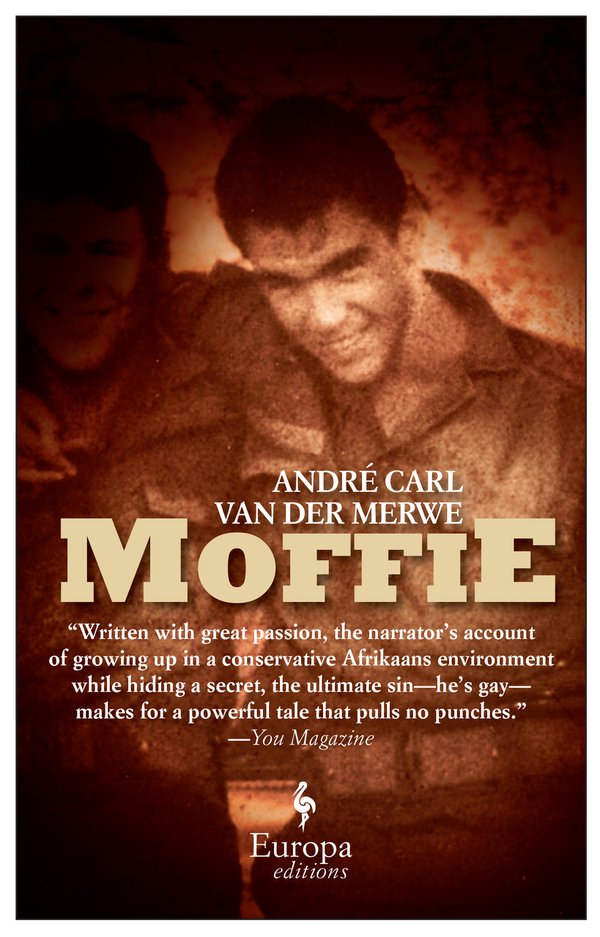
Moffie, a novel by Andre Carl van der Merwe
This book takes the trope of “The army will make a man out of you” and subverts it.
The writing style is interesting, to me it actually hovered somewhere between memoir and fictionalised novel. We have an highly abridged tale of his time in the army, interspersed with little vignettes of his childhood. I found it a little hard to follow at the beginning. Like, it was not always clear how the little short parts fitted together and where we were going with this thing; but it soon gains pace as the army parts take up a larger role in the story.
The author, with his choice of vignettes, manages to show the dimensionality of his characters. The father is almost always shown as evil and brutal, except when he isn’t. The mother, always supporting and protective, but also believing in many of the same poisonous ideas that come to dominate the protagonist’s life.
It is a coming of age story in that our protagonist goes to the army a scared and closeted boy and comes out a man. But his growth happens in spite of, rather than because of the army, the changes he makes to himself are in defiance to the army and of the government behind it.
But there is another theme running powerfully underneath this uplifting narrative, and that is what it was like to grow up a gay (or even effeminate) boy in South Africa in the 1970s. The book explores the way “men were supposed to be” and the toxic consequences of that thinking, and how ultimately so much of it was rooted in ‘what will other people think of us’. How little space there was in that society for people to be different (in any way). But most importantly of all, it shows the persecution homosexual men faced. And aligned to that the many ways these social attitudes left those men and boys vulnerable to abuse.
The importance of this theme, for me, is highlighted by the end of the book. We have the uplifting denouement, our hero has not only survived but thrived in the army, he has won his love, made special friendships, even gotten back at his main army tormentor. Then we switch to the last chapter and we jump into the short (and quite frankly) harrowing story of what happened to Dylan in New York. It is a wrenching tonal shift and a kick in the teeth; that seems to exist to remind the reader that while the narrative has a happy ending many of those boys it did not.
It is not an easy read, but well worth it for the social commentary and the authentic voice.
PS: I should also note there is a movie too