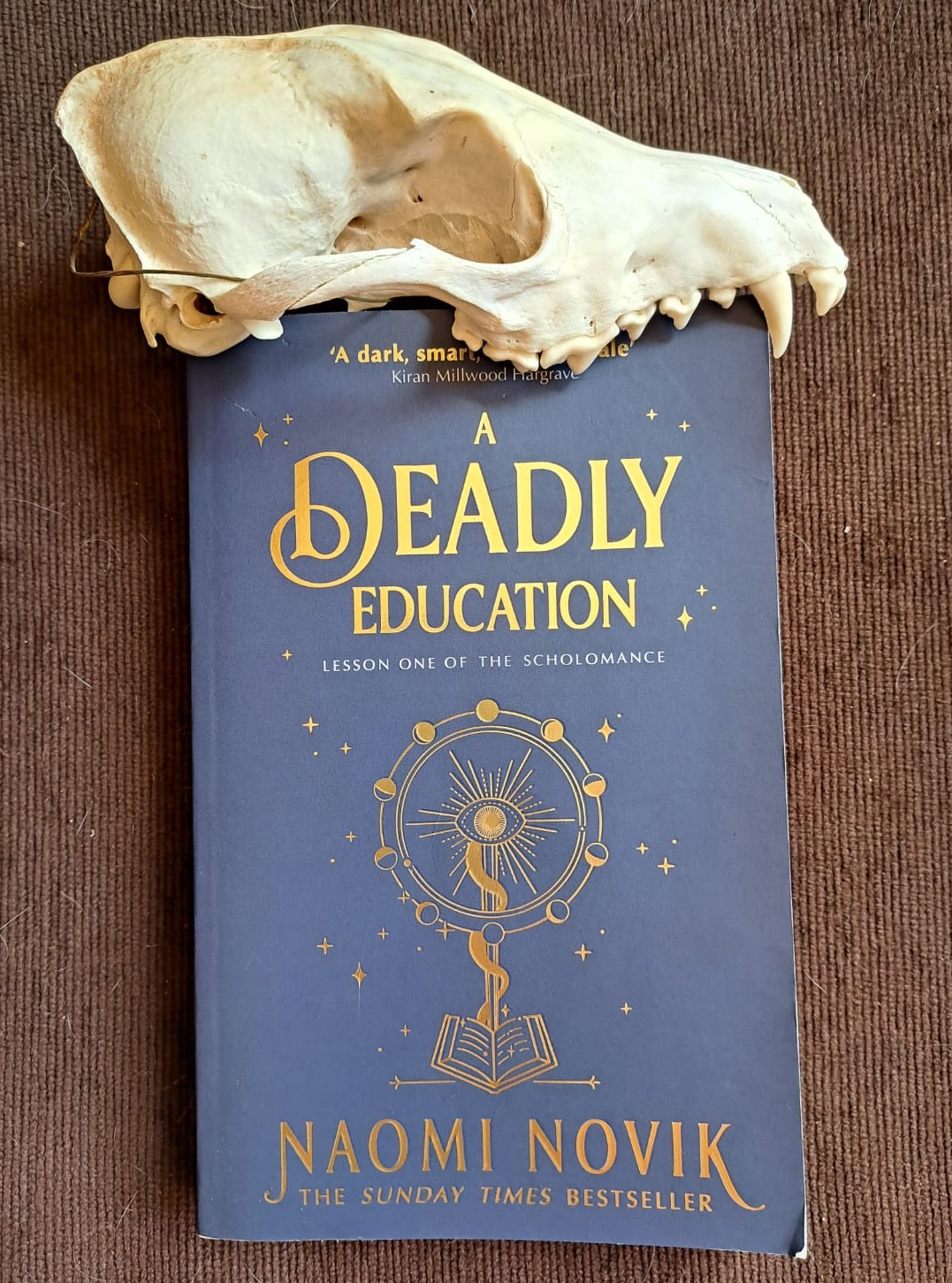
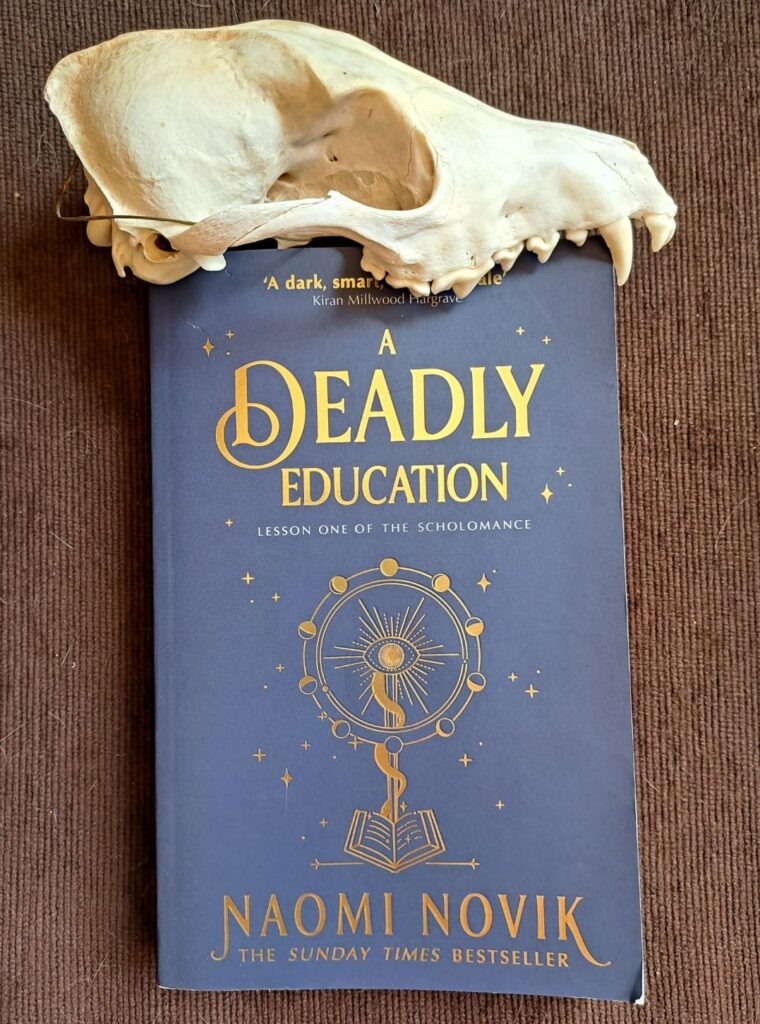
A Deadly Education by Naomi Novik
I have to be honest, I wasn’t so certain about picking this up. Magic-school books kinda turn me off – I feel like they all pale by comparison to HP. And also some are really teenagery and angst-to-the-max, and I’m sorry but I’m too old for that shit.
But this book, oh my god. This book took the premise, walked it over to the dark side and then dialled it up to 11. This isn’t a book about a magic-school, its a book about systemic inequality, about racism, about being fucking angry at the world. And it was the perfect way to round out the year – with a dark, intense, detailed story, bursting with character.
Stylistic Choices
What really carries this book is the narrator, El (Galadrial – but don’t you dare use that name). Her voice just drips off the page.
I absolutely loved her, she is profoundly relatable. A mountain of cynicism to cover the loneliness, the deep hurt of repeated and unprovoked rejection. The burning fury at the injustices of the world. And the devious plotting to have her share of the pie. With a liberal dose of false beliefs and lying to herself. I imagine a great many outsiders would have found something to connect with in El.
Although, I will note that many commentators who didn’t connect with this book cite the narration style, with its heavy emphasis on exposition, as one of the reasons. And yes, it is exposition heavy, but that is a specific style choice. Firstly, this is a fantasy book featuring a very complex world and character, that the reader needs to be cued into. It’s written in first person, as El talking directly to the reader, which gives her explanations a natural feel. To me it never felt out of place because it was clear that it was being used strategically.
Here is an example:
Take the scene in the graduation hall, the action is about to start coming hot and fast. Several monsters (mal) are approaching to attack. El describes some as just “scuttling things”, others are named, but with no description of what they look like or can do. But for another (chayenna) she gives a basic run down of how the creature came to be, because that story (of imperialism and colonial stupidity) reflects something important about the world and the story’s themes.
Subversions
This book is really all about subversions. In fact, thinking on it I feel like that is what Novik’s work is about at its core. Subverting tropes and expectations to force us to take a deeper look at our world.
At the centre is a subversion of the classic hero/villain dynamic.
First by making the ‘villain’ the protagonist. But then by asking what does it mean to be a villain? El has all the prerequisites. Anger, resentment, freakishly strong power, there is even a prophesy.
Except one – she doesn’t want to be one. This is a book where everyday El makes the decision to be a good person, even if it kills her. And it nearly does, frequently. She really does show the unrelenting effort it take to be good, to hold to your morals, to make authentic choices in the face of the expectations and provocations of others.
And I have to applaud all the complexities of El’s backstory. The ironies that are actually truths. The way it both shapes her as a character and alludes to the story’s development. It is simply masterful.
By comparison our hero is an idiot – unthinking and entitled – although El is busy shaking the rocks loose in his head. He is also more emotionally unstable and dependent than El. You don’t expect the hero to be the emotional train-wreck. The story uses it to ask whether it’s moral, what we ask of heros. It explores the ways we invent narratives about people, and how those stories then trap people in roles they don’t want, or are not suited to, and the damage that can do. I can’t wait to see what the author does with this character, ‘cos there is so much scope for him to fuck things up.
And from there the author then subverts the expected romance (I wonder if this could be a response to the romantasy stuff?). First by having the characters be more interested in surviving than initiating a romance. Yay to real people with believable priorities.
And then by completely wrecking the romantic moment. It becomes a point of high humour in the story and also a bonding moment for the girls.
you suck at romance
It is probably my favourite moment in the book. I feel like it adds a gravitas to the whole story, and to their relationship.
Finally, on the subject of magic schools. This isn’t a school, its a prison. There is no nostalgia, no found family vibes. This is all school yard bullying and toxic workplaces. It’s a dog-eat-dog world and anyone who has played those games and lost will feel seen in this book.
Not racist enough?
Another thing I have seen some commentators complain about, is that the book is not diverse enough for them. Which, I mean – were we even reading the same book? This is probably the most diverse fantasy I have ever read. Of Americans there is the New York group and one other person mentioned – because the world does not revolve around the USA. In fact the whole western world gets little mention, just enough to show they exist. But there is a huge representation of other other nationalities, especially African ones. I suspect there are languages and nations mentioned in this book that most of those commentators have never heard of.
I think what they were complaining about was that racism wasn’t centered enough for them in this story. Which, also, did you read with your eyes closed? The racism is EVERYWHERE. So the question becomes what were those readers expecting?
This book, unlike many others, does not have the protagonist moaning in her internal monologue about how she was unfairly treated ‘cos of the colour of her skin, and how that’s wrong and we should all do better. To her it’s a reality of the world, not worth dwelling on, and the least of her problems.
But, more importantly, it’s done this way because racism is not the central theme of the book (we are coming to that). It’s not the central way students at the school are separated. Another aspect may be that most of the racist incidents are not things that happen in the Scholomance, they are things that El experienced outside school, which she relates to us as reflections.
Here are some random examples off the top of my head:
They would automatically switch to English when they saw me, even if I spoke Welsh back to them.
Faces like mine that the kids at school were just starting to teach me were wrong but here were so obviously right.
(Paraphrased) The people in the commune asking El to assure them they were not being culturally inappropriate to Indian people
If you want to be angry about racism you will find plenty in this book to boil your hair, but you would be missing the real point.
Systemic Inequality
This book is about systematic, institutional inequality. The enclavers, who are the haves, against the independent wizards, who are the have-nots. But what I loved was the nuanced approach Novik took to the subject. Specifically, that everybody knows the system is unfair, but:
we all want to be on the good side of the unfair.
She looks at the root cause of inequality and accumulated wealth – wanting to feel safe – and follows its progression into the system we see here.
She looks at what people will do to get a foot up on the ladder and why (like the murderous competition for valedictorian, or the devil’s bargains made by maintenance-track kids).
And what people in entrenched positions of power will do to stay there (filling the Scholomance with independent kids as a buffer so their children will make it out).
It shows how easily the establishment of these systems leads to the dehumanisation of outsiders (like how Todd and the enclavers could justify his murder of another student).
And how even when you have won the top prize – entry to an enclave – it’s a poisoned chalice (like the Valedictorian who is forced to continue working with Todd or risk jeopardising the place she had worked so hard for).
That, at the end of the day she never really had any choices.
In conclusion, this book is facinating, complex and fast paced. It rounds off nicely, but with plenty of scope for the next in the series. I cant recommend this enough to anyone.