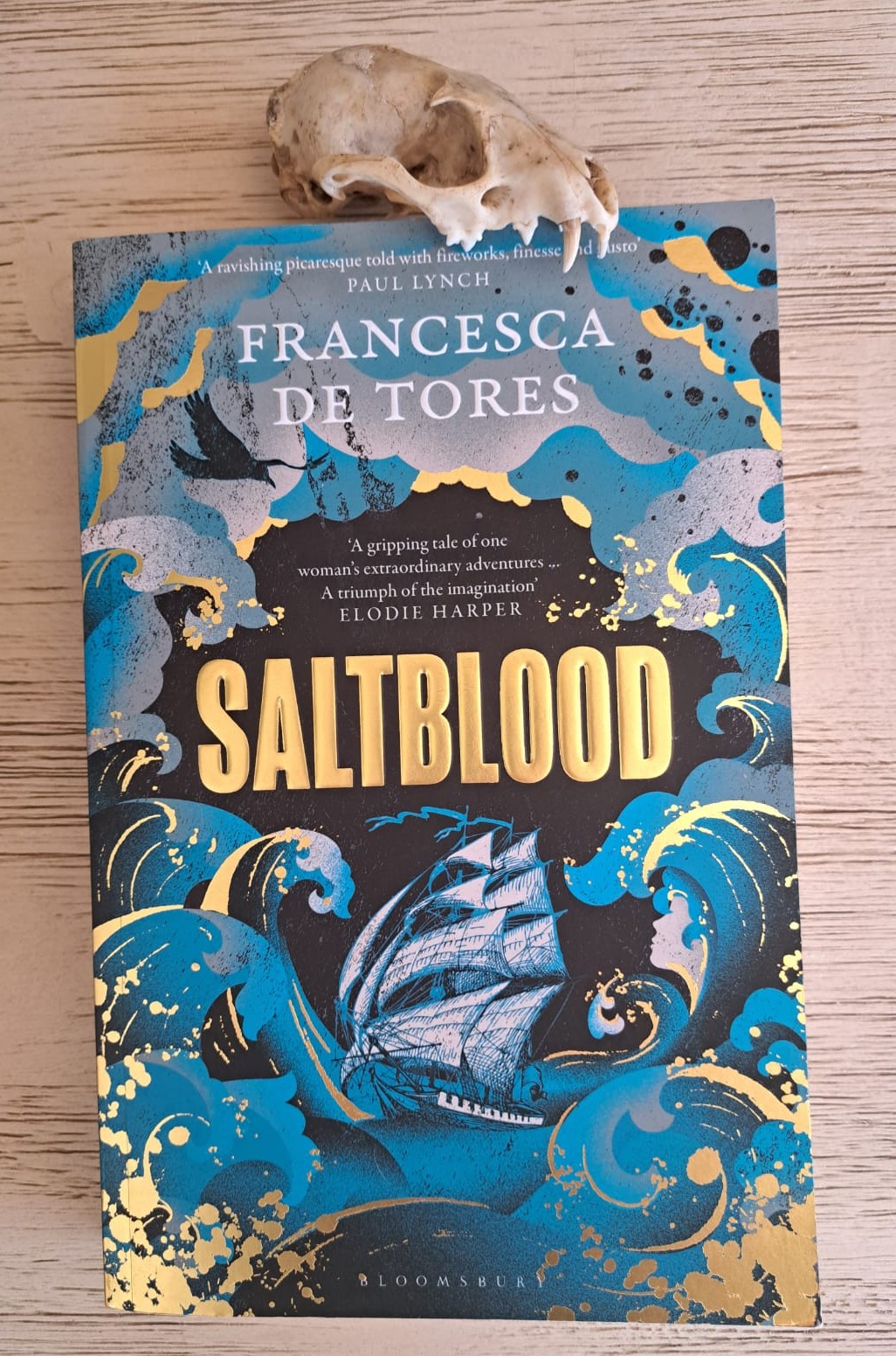
Saltblood by Francesca de Tores
This book is a fictional account of the life of Mary Read the female pirate – a real historical figure.
To give you some perspective, I did know, in a general kind of way, about Mary Read. I was a teenager when the first Pirates of the Caribbean movie came out and we were all enthralled by it. And so I hit-up the internet to find out if there had actually been any female pirates. And I read an abbreviated account of Mary Read and Anne Bonny.
That they sailed together on the same ship, that they both had relationships with other crew members on the ship (I think, even in a deeply closeted state, that detail never sat right with me), that at least one of them once won a duel by ripping open her shirt and firing upon her assailant while he was transfixed by the sight of her boobs. Clearly it had something of an influence on me.
But, somehow, I never really understood just how remarkable Mary’s life actually was. And I am actually a bit angry that long ago article kept such amazing details from young me.
Stylistic thoughts
This story tracks Mary’s life, the way she was raised as a boy, likely as an inheritance fraud. And the continuation of the lie into her adult life, pretending to be a man so successfully that she was able to serve in both the navy and the army without being found out. It would seem from the records at Mary’s (and the rest of the crew’s) trial that she had given up the pretence of masculinity by the time she turned pirate as the documents at the time record her as a women.
The facts alone would make for a fabulously interesting story, but the author brings Mary and her world to such life. The characters are all vivid and realised. Take Anne, for example, Mary loves her, you as the reader kind of do too. But that doesn’t mean we shy away from the ways that she is callous and self-absorbed.
Further the author makes brilliant use of vignettes, little episodes of life, a few scenes to covey what is sometimes years. It was a really effective way to cover a story of such a long time period. To keep the reader emotionally connected to the time jumps. I have been experimenting with a similar style recently and it was really inspirational to have such an exceptional example on hand.
One critique I will make is in the introduction of the character Sam. He comes into the story and disappears again very quickly, but in a manner that emphasises, rather than hides, that his purpose is to provide the author an opportunity to explore the racial dynamics of the setting. My criticism was not that he was there, just that it needed to be baked in more.
I loved Mary in the way she lived her life, authentically. The way she asked for no permission and waited for no approval. How the author still caught her insecurities and struggles. Even right at the end she holds no grudge for being left alone to die – it gives her the space to do so in her way. Without the distraction of people.
Identity and Gender
The author really uses this book, and its protagonist – a girl raised as a boy, who lived as both a man and a woman – to dig deep into a lot of ideas around gender and identity.
What does it means to be a man in the world, what does it mean to be a woman?
How uncomfortable it makes people when they cant neatly slot you into these (or really any) boxes.
A thousand ways in which woman are disadvantaged and the myriad ways men unconsciously hold them there.
It explores what identity means to us on an individual level – who and what we think we are, in conflict to what the outside world thinks.
And how identity shifts. The way it can be setup or programmed for us as children. And the lifelong experience of stripping back those assumptions.
It explores the many ways identities may not fit with normative moulds – and the way the difference between normal and abnormal is often a matter of perspective or mental sophistry. Look at Tait and his perspective of what counts as homosexuality.
I want to be clear here, this thinking looks at gender, and gender roles, but also the difference between piracy, honesty and morality, at virtue versus wantonness (Anne) and different kinds of homosexuality (Mary and the Reverend) and faith too. I think it leaves the question to the reader whether any of these are in fact solid concepts or merely fragments of a blurred line of imagination.
Female Autonomy
As for what the story is about, well the sea is obviously freedom, and the crow is death (Mary tells us that right at the end), but I don’t think any of that is what this book is about. I think at its heart this is a story about autonomy.
And nothing signifies this more than the crow, who throughout the book Mary maintains is not hers, the crow is its own creature and chooses where and how it will go.
It is strongly and repeatedly compared to the way the men in their lives view Mary and Anne. Not only claiming ownership over the women, but also superseding their autonomy. Jack when he interferes in their attempt at immolation to save his wife and child. Or when he tries to minimise Mary and Anne’s relationships as being less than his and Anne’s. The book is full of the deliberate removal of female autonomy. That Mary holds fast to hers is amazing and heartening.
I also found it interesting the way the book frames autonomy as being in conflict with survival. Or maybe it would be more accurate to say that female survival is conditional on conformity and adaptability.
This book is not just a tale of swashbuckling adventures, but a deep look at what it means to defy conformity and what it tells us about society.
Deep and personal and reflective, I cannot recommend this book enough.