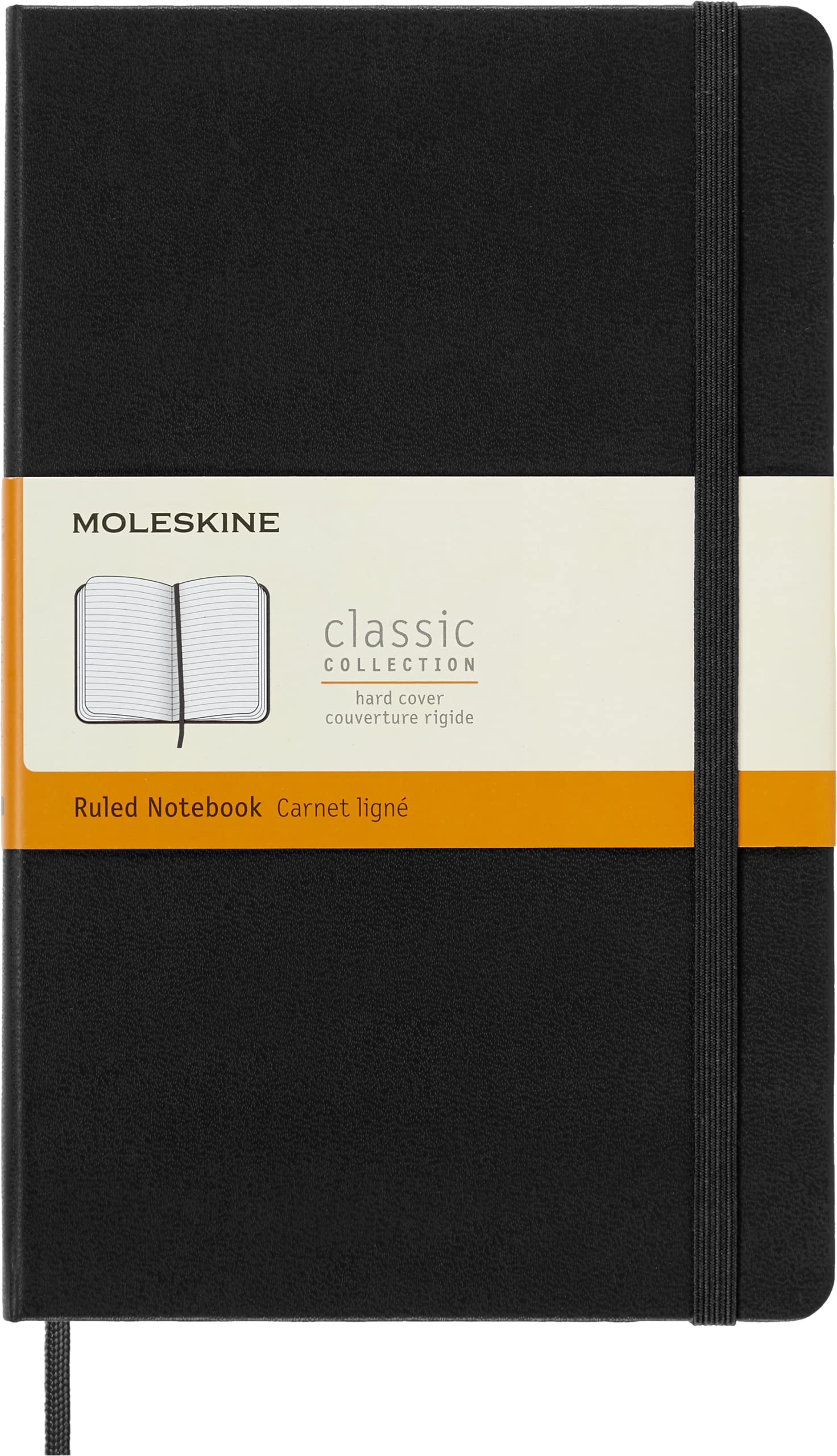
Moleskine notebooks are ubiquitous. Every stationery shop, every book store sports a carousel of them. Something I am pretty sure is true across most of the planet at this point.
But they are (at least in my country) extraordinarily expensive. Like it is over R500 for a A5 notebook. That is more than you will pay for the latest best-selling novel in hardback. It is an insane price and one I have never been able to justify for a book to scribble in. In fact it’s only really recently that I have been comfortable with buying notebooks are that anything more than utilitarian (but that’s a discussion for another day). So when I found a moleskine in a warehouse sale, I felt like this was my time to test what makes these notebooks so special.
History
Lets start by exploring where these books came from. Perhaps, like me, you assumed that they were named for the source of their leather? Well I can assure you that no moles (or any other animals) were harmed in the making of these notebooks. The cover is not leather at all.
In fact, the name Moleskine is a anglicisation of the French name for a type of notebook with a cover of oiled canvass that was commonly available in places like Paris at the turn of the 20th century. These traditionally made notebooks were very popular with artists and writers, including Vincent van Gogh, Pablo Picasso and Ernest Hemingway. But time moved on, preferences changed and they fell out of fashion, to the point where the last workshop closed in 1986.
Resurgence
So, how do we go from a notebook that functionally doesn’t exist to their current popularity? Well the modern notebooks were a project started by a designer and entrepreneur. The entrepreneur/investor was looking for a new product for his brand – Modo & Modo, that could be marketed into the next big thing. He invited a group of friends onto his yacht for a brainstorming session (as you do).
The designer, Maria Sebregondi, a literary minded-person, was reflecting on the artistic habits of famous artists at the turn of the 20th century and specifically their use of a specific kind of notebook. The association was obvious. It was the ideal product for the working or aspiring artist. For the new generation of what she termed “contemporary nomads”.
The team was fired up by the idea. Months of research followed to get the design just right. Little details like the flap for loose pages and the rounded corners for sliding it out of bags. And even more research into the manufacturing, how the oiled-canvass was made in the past, how something equivalent could be made now. Until finally the Moleskine was launched in 1997.
My thoughts
So is the success of the Moleskine just clever marketing, or is it a genuinely superior product?
Between journalling and handwriting my stories, I write everyday, multiple pages. I’m filling a journal a month. And when you use an object that much you become very particular about what you want from it.
And honestly, I was rather disappointed by the Moleskine.
Let’s start by comparing it to the journals I normally buy. This book is a hardback with a faux leather cover, firm enough to write on no matter where you are but with a soft feel to it. Although admittedly the covers will start peeling in a few years time. It comes in every colour imaginable, the downside being you can never seem to buy the same colour twice (not that it bothers me). The pages have a nice wide line, an elastic to hold the book closed and a loop for a pen. Total pages is around 80. But its biggest advantage is that it costs a measly R80.
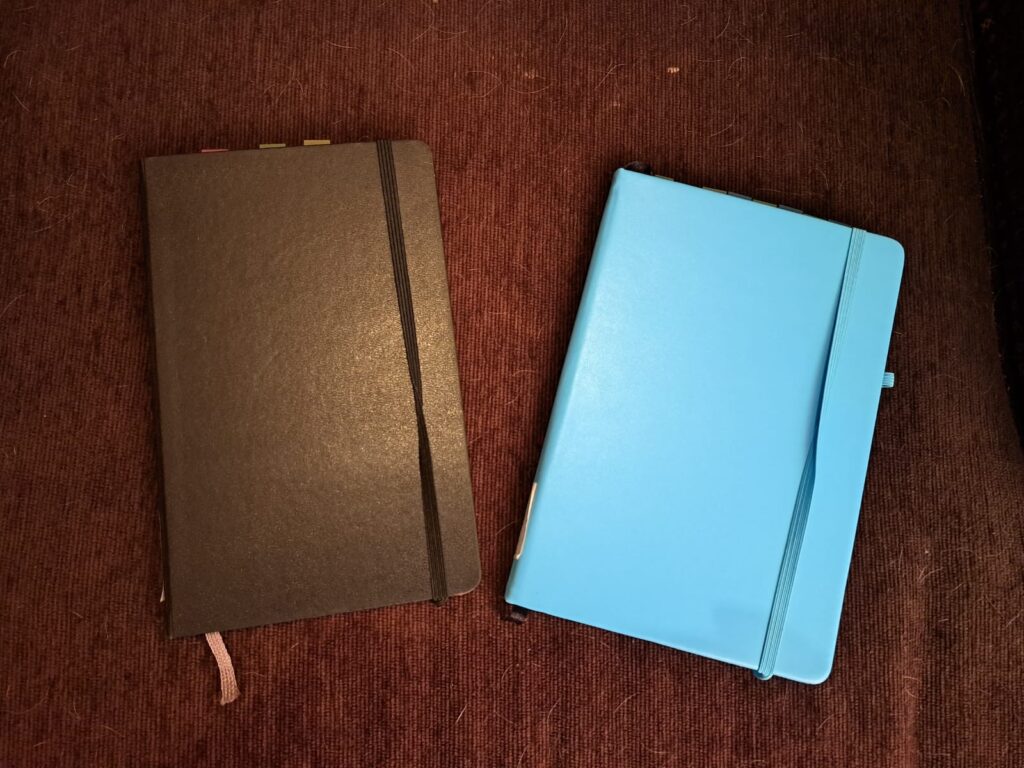
The Moleskine
The biggest (only) advantage the moleskine has, in my opinion, is that it has many more pages. About half as thick as my notebooks once filled.
And it has a built in pocket for loose papers. Which I can’t say I ever felt I needed before this book. And honestly you can install one really easily with just some scrap paper. I suppose it depends on how much loose paper you carry and the environments you write in, whether this will be a game changer for you.
Paper quality or thinness seemed about the same. Pens with really thick ink bled slightly through in both books.
The first problem with the Moleskine jumps out at you as soon as you peel the plastic covering off. It’s that cover. I don’t know if these are still being made with oiled-canvass but it feels cheap and plasticky. The material is hard and slippery, it lacks that padded softness of the faux leather. It just doesn’t feel as nice. It doesn’t sit in your lap, its always trying to slide away, like your thoughts and observations are trying to get away from you.
For me, one of those oddly irritating characteristics was the absence of a loop for my pen. I’m forever carrying my notebooks around, constantly shifting them between different bags, carrying them from room to room. When you have a loop you can dedicate a pen to that notebook. You are never caught out with a book but no pen. It’s infuriating. Although I will grant if you have a favourite pen you always write with (like a fountain pen) then maybe attaching it to a specific notebook doesn’t make sense for you (you weirdo).
But the deal-breaker for me was the line-spacing. The lines in the moleskine are closer together than in my notebooks, that means each line space is smaller. That shouldn’t feel like a big deal, but it was. My handwriting is big and messy and it was really uncomfortable trying to squeeze it into this narrow space. Just thinking back on that makes my hand cramp up. This is a really subjective quality to judge a notebook on, but then notebooks are really personal spaces.
Are Moleskine’s worth it?
Subjectively the Moleskine holds none of the qualities I desire from a notebook.
Objectively, it is worth that price? Absolutely not. It offers no superior quality to the cheap notebooks I use, and in fact has fewer add-ons.
Honestly, I think we need to acknowledge that what you are buying when you get a Moleskine isn’t a superior writing experience. You are buying the appearance of inclusion into a certain perception of artistic. And while I still think they are overpriced junk, I am none-the-less planning on seeing if there are any available in the warehouse sale tomorrow, ‘cos I cant escape the associations either.
Wikipedia has a good article on the Moleskine
And I originally learned the history of the notebooks from an interview with Maria Sebregondi