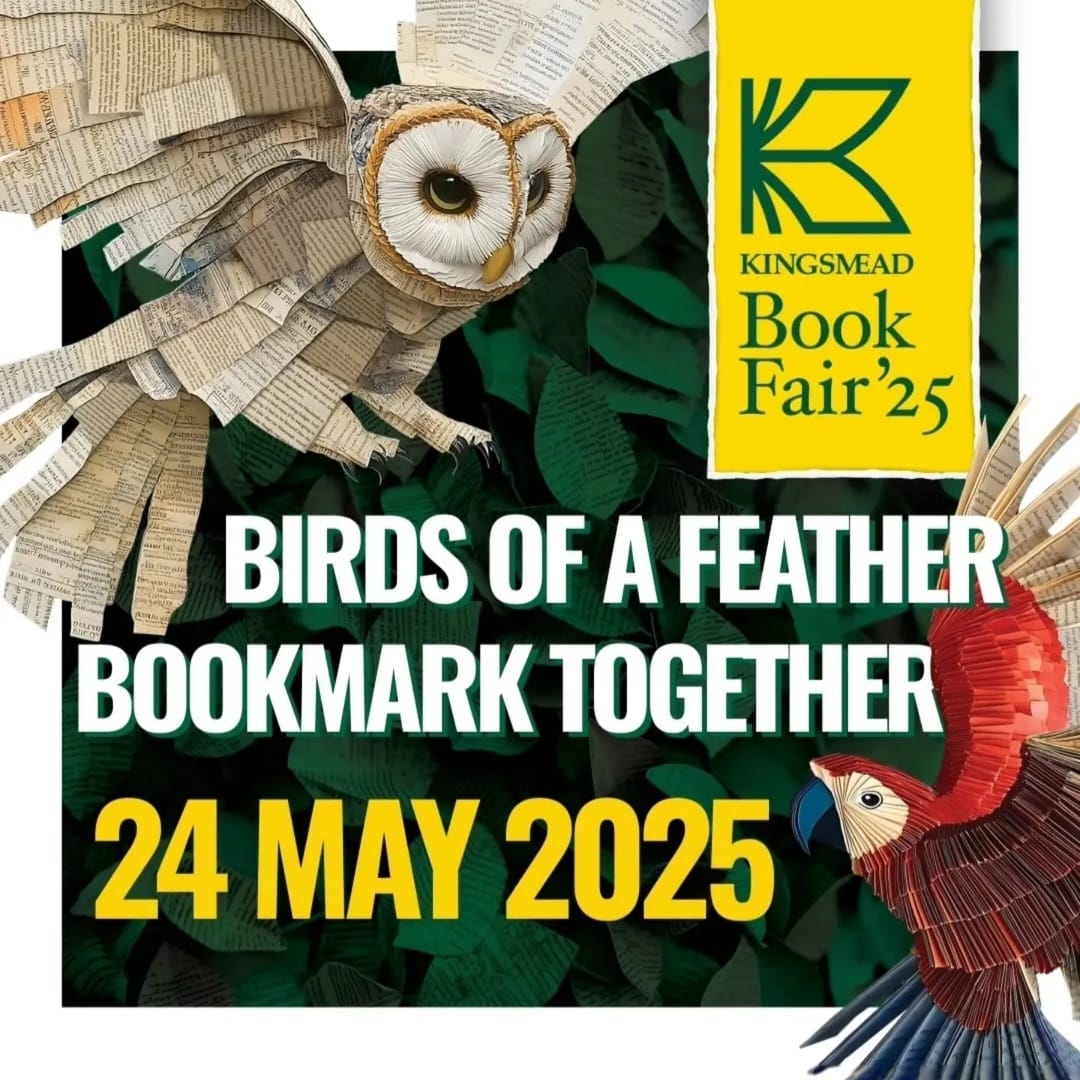
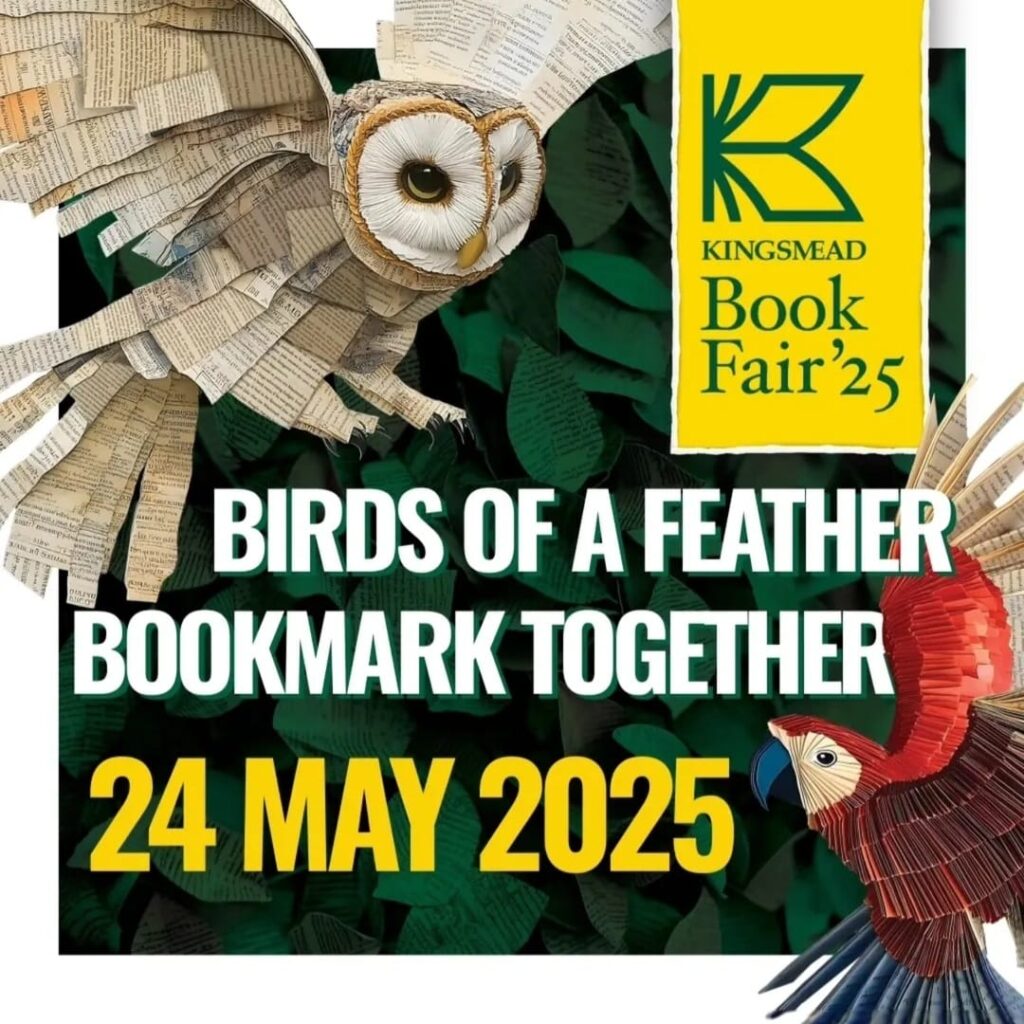
I think today I want to tell you about my favourite bookish event – possibly my favourite event ever – the Kingsmead book fair.
Admittedly it’s been almost 2 months since I attended, but this year’s event is still resonating in my daily life – so like an ear-worm I decided to share the ‘pain’ with you!
Kingsmead
For those who have never heard of it.
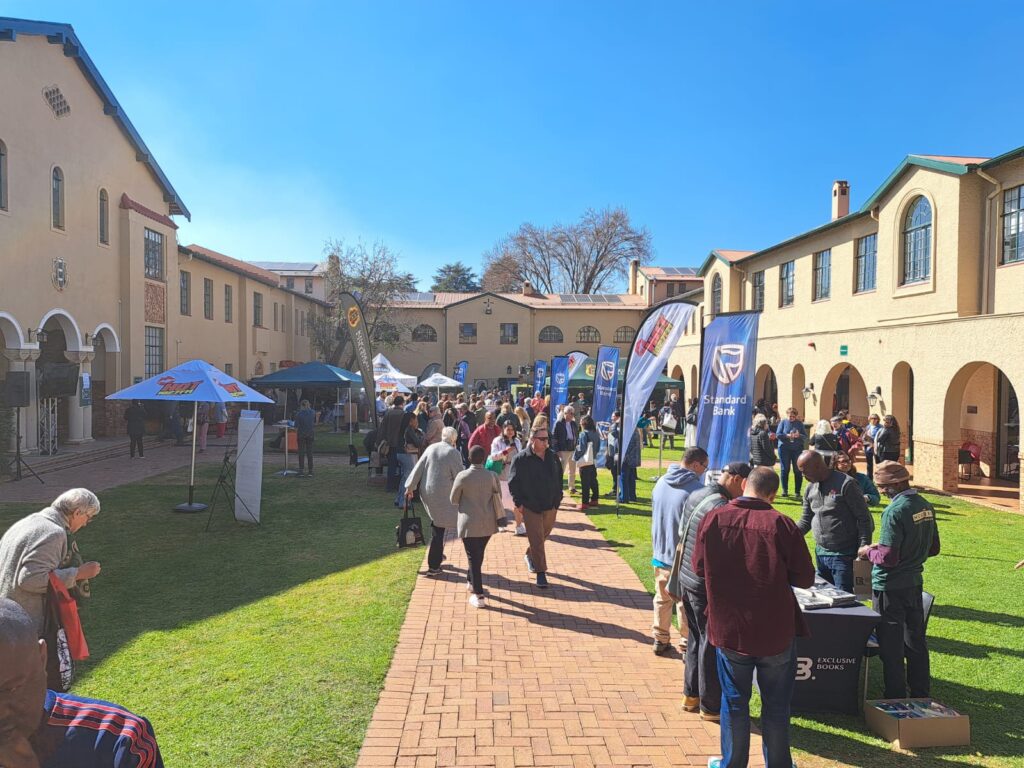
Kingsmead is actually this tiny exclusive girls school tucked away behind the Gautrain station in Rosebank, Johannesburg. It occupies all of a city block. And every year on the last Saturday of May they host a day-long book fair, that is simply incredible.
The school grounds are beautiful; classical buildings in soft creams, interspersed with lovely gardens, so the space is incredibly inviting. The school goes all in on this event. It opens its many spaces as venues, so you could be sitting on mats in the theatre, or in the music room trying not to knock over the drum kit, or doing a cooking demo in the science lab (don’t get the jars mixed up!). Every venue space is fully kitted out with a raised platform and comfy chairs for the panelists that maximises visibility, performance quality audio equipment with technicians to manage it. There is an artisanal beer/wine tent and plenty of food trucks. And the best part, there is even a pop-up bookstore!
The fair is structured around five sessions over the course of the day with a wide variety of talks or workshops for one to choose from in each session. They even schedule time after each one for people to go buy and get their books signed by the authors.
Every session is based around a theme and will have a panel of local authors (usually people who have released a new book within the last year) and the talks are guided by a facilitator who is either an author themselves or a journalist (or similar). It is, oh course, a chance for the authors to advertise their books, but the discussions go so much further than that, looking at craft, at the writer’s life, at the socio-political experiences of living in South Africa, at history, at the future, everything.
I go home from this event exhausted in the best way possible every time.
2025 Book Fair
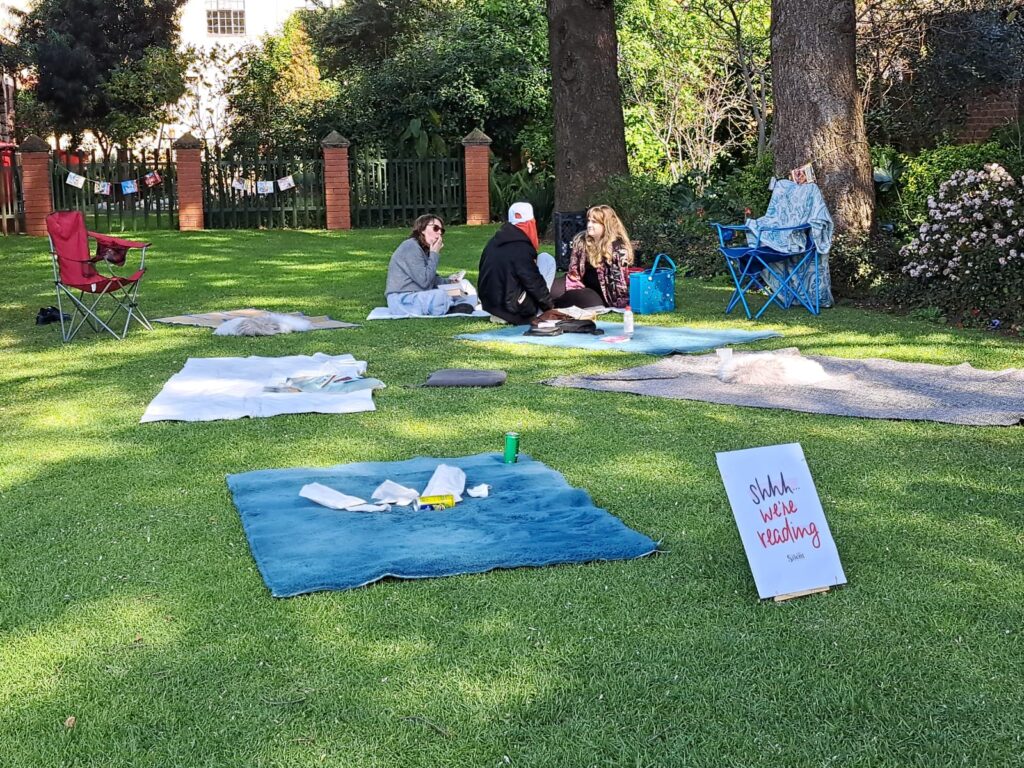
I feel like every year there is a gentle expansion of stalls or events that are more book adjacent (in a good way), like this year the Jozi Silent Book Club had a “stall” at the fair, blankets and pillows pilled on the grass under the cypress trees. Or like a workshop on journaling – more on that in a moment. I also feel that the number of sessions aimed at aspiring writers, that is looking more at the craft side of the books has increased. Which I deeply approve of.
For me there is always a real battle over choosing which talks to go to 1) ‘cos I cant be in multiple places at once, and 2) ‘cos da budget will only stretch so far. This year required a priority list and the final decision came down to:
- Mark your memories: Putting thoughts on the page.
- International relations: People and place in historical fiction.
- Literary fiction versus genre fiction. What makes a book ‘literary’?
- Taboo tales: Is it possible to write a luscious love scene?
Mark Your Memories
This was a journaling workshop with Antoinette McDonald of Do The Heart Work. And it was hands-down one of the most transformational and important literary events I have ever experienced.
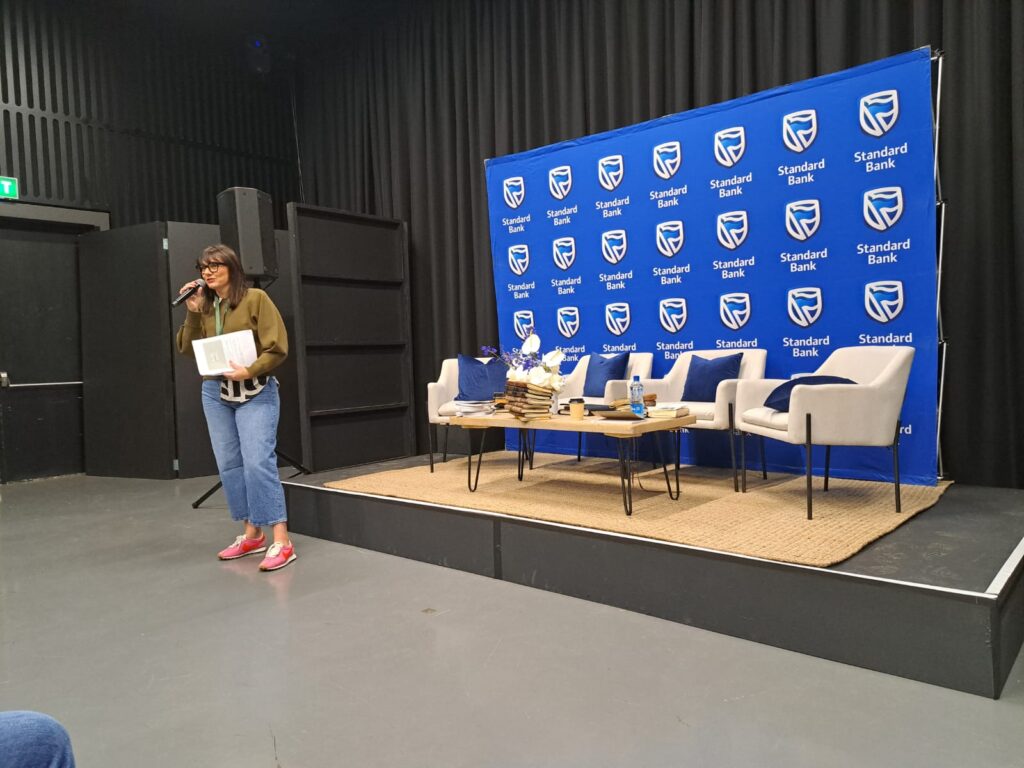
I should say that I went in there hoping to unlock this process. You see I had been doing the ‘morning pages’ journaling for about a year, because my writing teachers had recommended it as a means of unblocking one’s creative process. But lately it had been feeling very mundane and mechanical. My journal was full of lists, what did I do yesterday, what do I plan to do today. And while they do say there is nothing wrong with writing lists in the journal, I was looking at it and thinking there must be more to this process than this?
Over the course of Ant’s talk – it wasn’t really a workshop, there just would not have been sufficient time – I realised that there was a great deal more:
That a diary is where you record what happened. In a journal you record how it felt. So simple, but man somehow I had not grasped the difference till Ant pointed it out. She talked about writing to let the words out, to heal to remember. Write for no one to see it. To use the emotion wheel to find the words for how you feel. That if you skimp on your inner life, then your outer life stutters. To champion yourself.
But the truly transformational part came afterwards. She was selling a little book. Her own 21 day guided journey to help you reflect, reset, reconnect. Featuring 21 writing prompts paired with a personal story, and filled with pretty pictures.
I will admit to fighting myself over this purchase (I was nearly the last person left in the room), ‘cos I had only budgeted for a single book purchase and I didn’t want it to be a tiny pamphlet, but I beat down my inner miser, massaged the budget somewhere else, and I don’t think I have made more meaningful purchase in the last year (or possibly several years). I talk more about journaling and what it has meant for me here, as it deserves its own space.
International relations
I walked into this talk knowing nothing about the authors or their books, just interested in historical fiction. So I got the shock of my life when the second author (Penny Haw) announced that her book (Follow me to Africa) was a fictional biography of the celebrated palaeoanthropologist, Mary Leakey. I sat up like a meercat – like what were the chances?
Obviously I bought this book, and got it signed – post to follow.
So this session wasn’t exactly historical fiction but more about fictional biography – which if like me you have never heard the term – means it’s a fictionalised version of the life (or parts thereof) of real famous people. I did not know this was a thing you could do.
The other authors were Louisa Treger, who in her book (The Paris Muse), explores the life of Doris Maas. Doris was Picasso’s mistress and the inspiration for his weeping woman portrait. Maas and Picasso had a complex relationship where Maas, a talented artist in her own right, started the affair as an equal, but was eventually completely subsumed and arguably consumed by Picasso. Another tragically unacknowledged story of the patriarchy.
Siphiwe Gloria Ndlovu used her book (The Creation of Half-broken People) to explore the life a woman of colour from the King Solomon’s Mines story. I am embarrassed to admit that even after this talk I still have no idea how fictional this character is.
So what did we learn?
Historians tell you what happened, novelists tell you how it felt. For example, Haw described how dry and unemotional Mary Leakey’s autobiography was, that she tackled this project in no small part to ask the deceased scientist: “But how did that feel Mary?” She wanted to explore what it was like to build a trail-blazing career in this mans-world with no formal education.
Historical and biographical fiction, the panel explained, is about filling in the imaginary gaps between the facts. They advised writers to use the facts, but not to feel too constrained by them. That research could inspire new story ideas and leads – “half-broken people” came from a line in a colonial report. While Leakey’s rescued cheetah was moved decades forward so it could appear in Haw’s book to drive the emotional arc of the story.
The session ended with the message that history is peppered with remarkable women (who have been written out of their stories) we just need to go looking for them.
Literary Fiction
This talk was very literary, surprise, surprise.
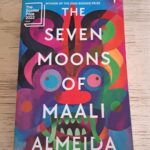
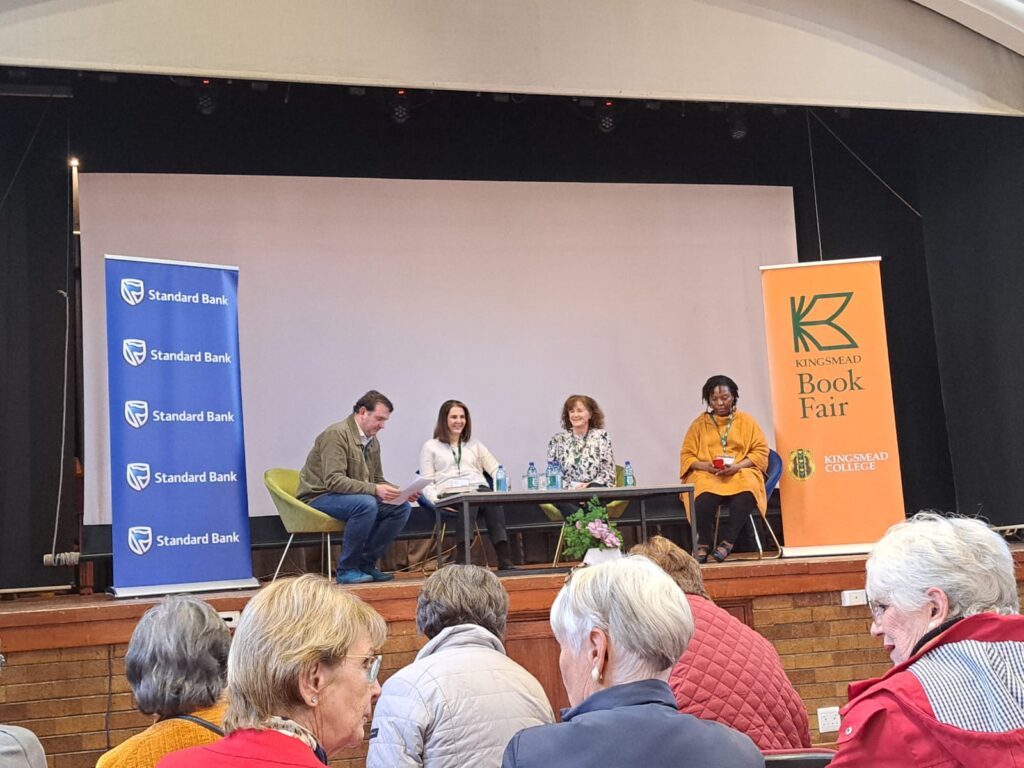
I went into this session with a simple question: what is literary fiction, in what ways does it deviate from genre fiction? I guess I was struggling with that question since reading Shadow on the Wind (there is a post on this coming up). The authors for this one were Peter-Adrian Altini (Salt water Pool Boy) and Charl-Pierre Naude (The Equality of Shadows).
So basically, literary fiction, as I understand it, has a strong emphasis on the intangible and philosophical. If you have that ‘I dont get it’ feeling, you are probably reading literary fiction. If other people start talking about the metaphorical meaning of the three witches, then you are reading literary fiction. If you feel a bit inferior after reading it and especially after discussing it you were definitely reading literary fiction. Sorry.
Literary fiction can use any of the characteristics, setups, tropes, etc of genre fiction. But as the panel pointed out genre fiction comes with very specific expectations. The joy of genre fiction is in the structural expectations – not that it means an author cant subvert those. Literary fiction, the panel insisted, has more of an emphasis on pressing the reader to think in a different way about the story or characters. It is also often more focused on beautiful language, as part of the enjoyment.
It was in short a very boring hour, with a panel who were trying not to be superior but not being all that successful at it. Also is it not just the most literary thing that the authors all had double-barrel names?
Taboo Tales
And this was just the perfect palette cleanser to end off the day. Literally one of the funniest hours of my life, as the panel discussed how and why they write erotica.
The panel was an interesting mix, the facilitator Jo Watson (The Ex Effect) was the only white person, and joining Jackie Phamotse (The Tea Merchant), and Busisekile Khumalo (Rubies and Rain) was a straight black man Rams Mabote (Sweatest Taboo), a rare bird in the erotica space.
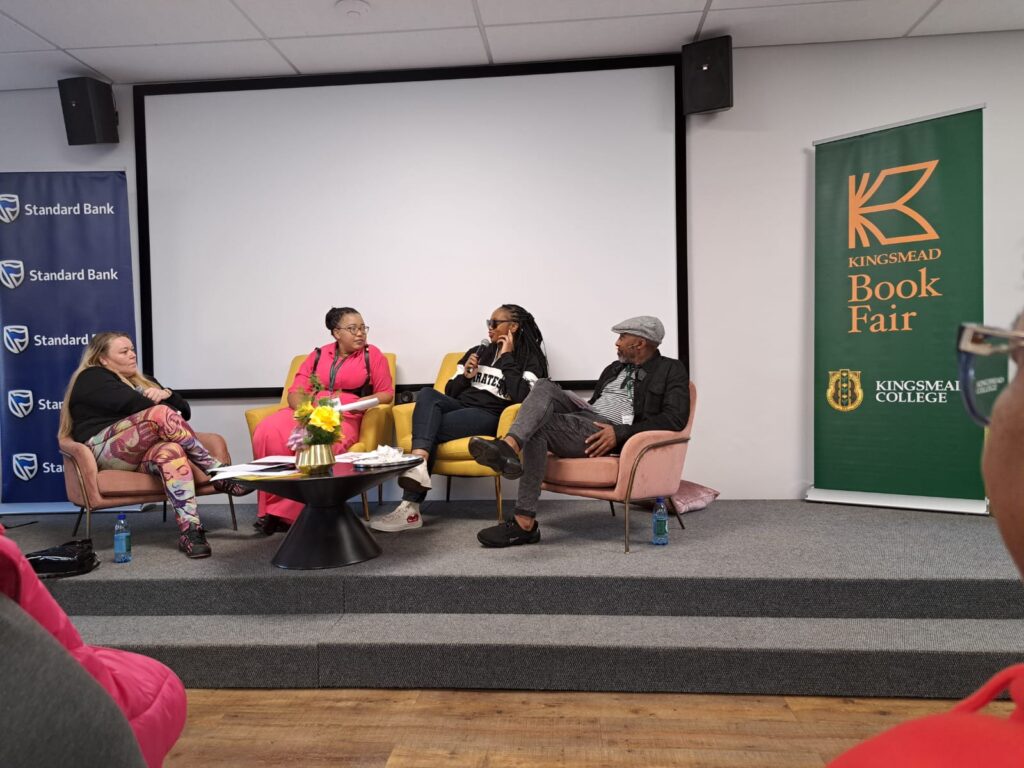
Jo opened the discussion by having the panelists rate the spiciness of each other’s books, holding up cards with chillies printed on them. For a short while things went smoothly with the authors reflecting on their writing process. Busi writes before bed – on her phone. There was a collective gasp of horror from the audience. While Jackie talked about setting a romantic mood, music and candles and what have you.
This somehow led to a mention of a sex scene in one of her books, and her admitting it was personal experience. The scene was banging on the bonnet of a car parked under the Nelson Mandela Bridge in Braamfontein.
“What colour was the car?” Cracks Jo.
“A blue porche!” Girl chooses her paramours well.
“But wasn’t the bonnet hot?” asks Busi looking confused, and a little embarrassed.
Jackie laughs. “Yes! That was the problem! He thinks she is really into it and she’s just trying not to burn her backside!”
(I’m paraphrasing here for artistic effect)
Well now she was on a roll. And I cant say I ever expected to get step-by-step instructions on how to have sex on a red open-top tour bus, especially not at a book event.
Apparently you have to take the sunset tour down Chapman’s Peak drive, and ‘also don’t make the sounds babes’.
It was an incredibly fun talk, the panel had fantastic chemistry. In terms of craft, they talked a bit about why you have sex scenes, emphasising that the scene needed to have importance for the characters. That, as an author, you had to consider more than choreography (can you get your leg in this position without kicking your partner in the teeth?), you had to consider what what you want the readers to feel (not that kind of feel).
All of them were proud, to the point of defiance, in their choices to write erotica. Talking about standing for something (subversive) or because somebody has to be unhinged. They all agreed that writing erotica for entertainment was as good a reason to do it as any other.
A question at the end also generated a lot of discussion was about how the authors dealt with their family responses and expectations. A few talked about having to prepare their children for the reactions of others. Jackie quipped that she doesn’t need to worry about this, she is still practicing (on busses and cars, apparently). But one author told a very moving story about her father’s reaction to her first book. How he made such a point of getting a copy to read. Then being so upset about the contents of the book that he wouldn’t talk to her for a few weeks, before resuming life without any discussion. Now he continues to read her books whenever she publishes a new one. And continues to silently disapprove.
And I don’t know if that is disheartening or moving.
I can tell you this, my mother will be forbidden from reading any erotica stories I might publish.
Afterwards I looked up all their books and I would have judged them normal romances based on the covers. All of them are published by local publishing houses. I will come back when/if I get around to reading them and let you know whether they are just erotica or driving towards more serious themes, Jackie’s books do seem from the discussion, names and covers to be rather deeper.
Reflection
So the 2025 book fair was especially meaningful for me and has increased my to-be-read pile by a substantial margin. But the delight in this day, as always, was in spending a whole day just doing the things I love best, surrounded by many other people who love books and reading.
It was the inspirational delight of seeing other people like myself, with similar or harder life situations and experiences who have battled through to finish their books. Who have gotten published. And who are out here sharing their time and hearts and experiences with others, not just to sell their books, but to share the joy books and writing give them.
Really is there any more to say than that?