
Catfish Rolling by Clara Kumagi
I cant believe I am saying this once again, but I have no idea what this book was about. How and why do I keep finding these literary fiction stories? And they are all hardcopy books I purchased, I cant even blame the algorithm.
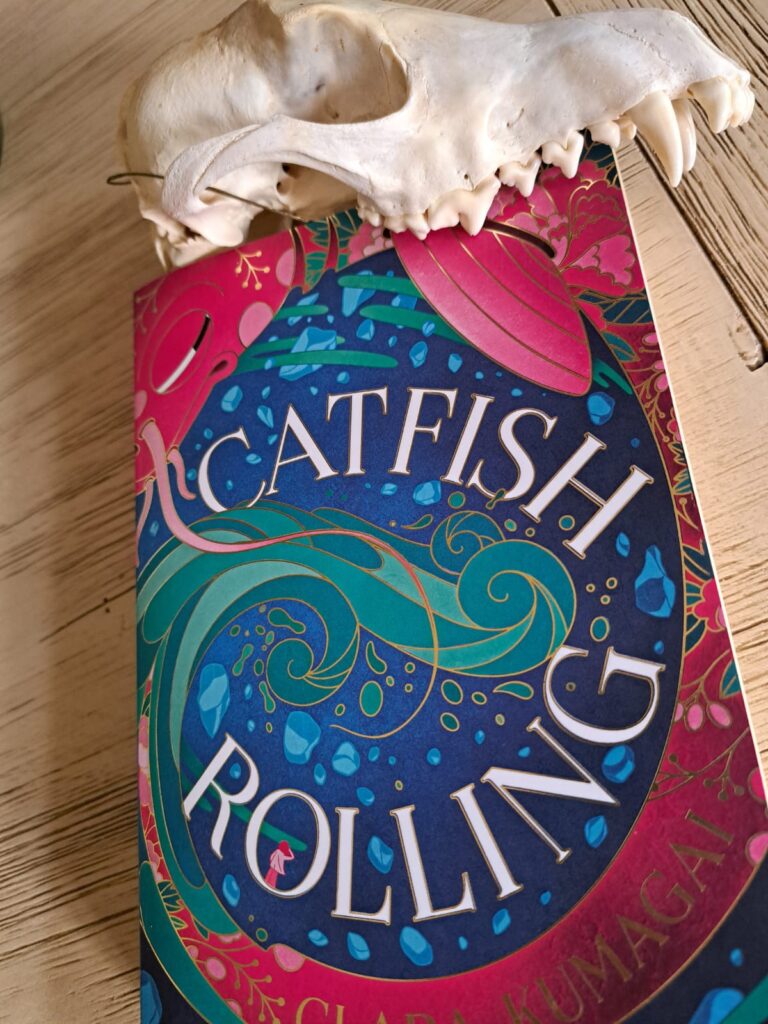
But, I mean, look at this cover, can you blame me? It was part of the box of books I picked up at the Exclusive’s Warehouse sale and I picked this one to read first ‘cos I thought it would be light and quick.
Boy was I wrong.
Breaking Expectations
It did play interestingly with the expectations of (all) its genres.
At the start it feels a lot like a fantasy, setting up fantastical elements like the quake that broke time, and a protagonist who has lost her mother and is obsessed with the time zones, and seems to have some special power related to them. It feels very much like its going to run down your traditional hero-fantasy tropes.
But then the reader gets drawn into the minutia of the protagonist’s life. We spend a significant portion of the book on the trip to Tokyo, exploring the the protagonist’s relationships with her best friend and her father, her future (or lack thereof). And the fantasy elements start to feel like metaphorical world-building – a context to explore humanness, which is very literary fiction.
But then we hit the climax and the story’s energy shifts again. I remember trying to tell a friend about this book and having to admit, 100 pages from the end, that I still had no idea what the story was about. Because we were having the confrontation with the father and not only was there plenty of book remaining, it was also not working to resolve their relationship. Instead the story turns back to the fantasy elements and our protagonist does effect a fantastical fix on the broken time, giving us an abbreviate version of the fantasy ending I was expecting right at the start, but pulling a lot of metaphorical elements along with it.
In the end, like Shadow of the Wind, the fantasy parts dont feel like the most important bits of this book, although at least they remain integral right to the end.
Metaphorically lost (as per usual)
And, I am left wondering, what did all of this mean? Like I get its really about grief and moving on from grief. And that time itself is a metaphor about that, broken time = broken lives. Slow time and fast time and being a slow time thing in a fast time world, unravelling. Like I can see that. What I struggle with is how far I am meant to take the metaphor. ‘Cos it doesn’t feel like an analogy, in this world time really is fractured. Does that mean that Sora’s grief broke the whole world? That we are all struggling with debilitating grief? And what does it mean for Sora, and for the world, that she fixed the time? How does that reflect the shared grief? And what the fuck are the catfish and the salmon supposed to mean?
I am taking this too literally I know. I cant decide if stories like this are drawing on a language of symbology I never learned, or if it reflects a way of thinking I cant emulate, but I don’t get them and I’m not embarrassed to say so.
Lets hope I manage to catch a break from literary fiction pretending to be fantasy.