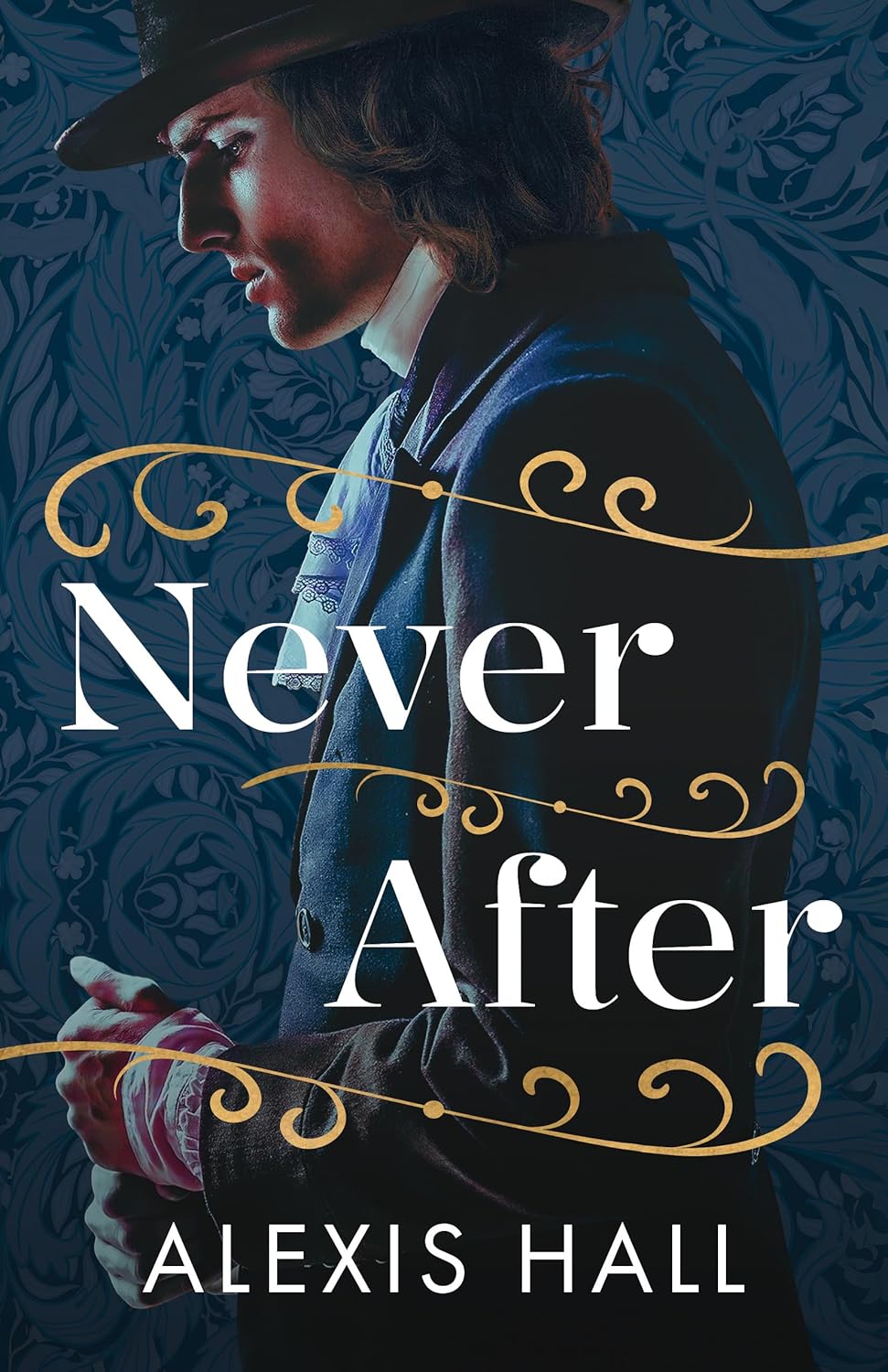
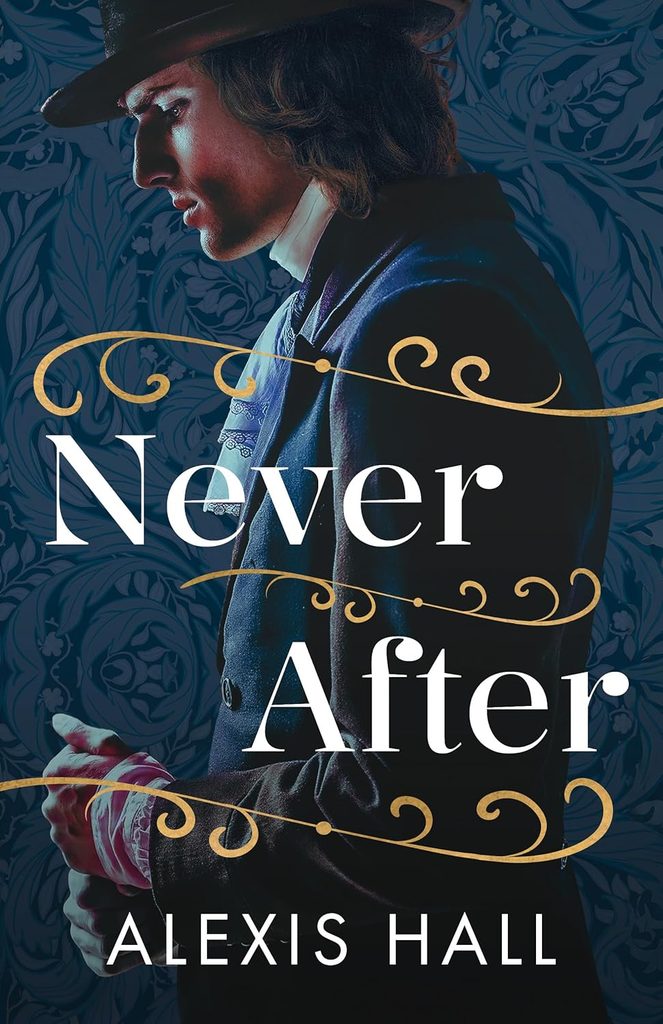
Never After by Alexis Hall
I swear to god I am never reading another book by this fucking author ever again.
This book actually starts out strong. Micah is a great character, nuanced and complex. The premise promises some great drama and the period setting is well built. But, as is generally the case with Hall’s books, the plot comes apart annoyingly quickly, and as the structure collapses so to does the characterisation.
Nonsensical ending
Lets start with the ending which legitimately infuriated me. Books like this are why I started this blog, so I could get them out of my head and no longer disturbing my sleep.
This ending makes no fucking sense.
Firstly, our couple kinda split-up with Thomas staying in Netterfield while Micah now wonders the length of the country, for reasons?
I don’t understand how this settles any of the conflicts of the story. Why does Thomas have to stay? He never shows any particular attachment to the place. He has no love of the countryside, or any friendships with the locals. Surely he can go be a priest somewhere else?
Why does Micah leave? He spends pages of the reader’s time waxing lyrical about the beauty of the place, making friends with the locals, insisting he never wants to go to London ever again. Why can’t he find a job and settle in Netterfield like Sheba does? (I think I’m answering my own question here – but if your primary characters can’t do thing because the secondary characters got dibs then you need to rethink your characters).
I would argue this is completely backwards because it was Thomas who expressed a desire for more travel and adventure.
And it was Micah who said:
I wanted to be someone to come home to
How does this ending support any of that?
And once they are parted, in this weird long-distance thing, that is never properly discussed, Micah immediately starts sleeping around and continues to do so right to Thomas’ grave.
We spent the first part of the book counting all the men Micah had to sleep with to survive, all the ugliness of prostitution and of being used. And I guess the author wanted to convey Micah taking power over his body and sexuality by getting to choose. Except for this:
The hands of strangers smudge the memories of Isidore that once gleamed upon my skin
Micah’s subtext was never I cant trust men anymore, I’m never having sex again. Because he certainly jumps into bed with Thomas, no fucking problem. It was about a man who had love and lost it. Who used to believe that sex was an expression of emotional intimacy and had that cruelly stripped from him.
Further, his new great love is a man of faith, who offers him a marriage-like arrangement, who is expected to simply accept that he will only get a part of Micah’s intimacy. It seemed incredibly cruel to me, by Micah and on Thomas.
It is also worth pointing out that Micah throws a massive tantrum when Thomas suggests marrying Sheba, “ in name only” and that it “would be some measure of protection for all of us.”
To which Micah responds:
its me who’ll be nothing
and
what parts of you is truly mine?
So it’s okay for him to dip his wick wherever he likes, but not okay for Thomas to make a legal arrangement that protects all the people he loves? This is jealousy and hypocrisy and did nobody read this bloody document before printing?
I also found it really offensive that when we are standing at Thomas’ graveside, with the flowers still fresh, and Micah has brought his latest lover along with him. Like wow. That’s a really special relationship you had there with Thomas, couldn’t even wait for the body to cool.
And I’m not trying to imply open or poly relationships are inherently wrong. But they need to be setup first. Agreed upon by all parties. Otherwise you are putting sparkly ribbons on adultery.
Setups that die
The worst part is that this terrible ending didn’t need to happen. There were plenty of conflicts in the book that could have been explored and resolved in a much more satisfactory manner.
Let’s start with this premise shall we? A gentleman priest and a opium addict rent boy. So, we can expect conflicts around faith, around promiscuity (or at least the societal judgements placed on prostitutes), around class divides and money, around addiction. Do we get any of these? As if.
Does Thomas the priest feel conflicted about being homosexual? In a word, no. He jumps straight to acceptance, with the justification that God must have created this kind of love for good reason, and the bible doesn’t forbid it anyway (that felt a lot like someone proving he did his homework). I will add that he is in this mental place already during the first make-out session. So that was a lot of expectation that goes nowhere. It also makes him one-dimensional as a character to just be chill with everything. He’s supposed to freak out, that’s what I paid money to watch. On its own, it wouldn’t have been a big deal, but this character was like that over everything.
The author then tries to drum up a new conflict by introducing the excessively manufactured fight about living in sin as a priest. Yes, it was that ridiculous. It was the priestly equivalent of I saw the love interest with another man/woman therefore they must be cheating, whoops turns out it was their sister/brother.
On the matter of Micah’s past as a prostitute. The conflict never happens. Micah never works up the balls to tell Thomas. The people who know about it (Sheba) or threaten to find out about it (Thomas’ brother) never tell Thomas about it. All these setups left rotting. And when the author does finally remember this was supposed to be a thing, Thomas’ reaction was pity. Then he ALSO never mentions it. Once again the vanilla man is not at all concerned to learn this shocking piece of information.
This was the thing the audience picked up this book for. If you cant deliver on that then why the hell did you bother writing it?
It’s not just a broken promise or a Chekhov’s gun either, this is a central part of Micah character arc left on the cutting room floor. I thought the point of a relationship (or at least the facsimile we are creating for entertainment purposes) was that you can and should tell your beloved the worst parts of your self and be loved anyway. All that shame at the beginging of the book, this was how it needed to be dealt with.
As for the addiction, Micah does admit to that and decide to stop taking the drug. Only, the problem is, he just decides it, with no inciting incident or driving internal conflict (this is a reoccurring problem of this author). And, no. That is not how people work. People are full of inertia. They don’t sit quietly and realise they need to change. People change due to outside forces. They have a car accident, their wife leaves them, they get arrested for stealing money from their elderly parents.
We then get “treated” to a long montage of withdrawal and recovery, that doesn’t lead to anything story wise. Micah get clean and that is it. He’s not really a different or better person afterwards. The relationship isn’t changed. There is no drama or conflict behind any of it. He never has a rebound. It’s just pages and pages of a thing that happened – rather boring.
Look, I know the world feels like a dumpster fire right now, and that maybe an author finds he doesn’t have the appetite to wrestle with difficult things and hard emotional truths. But you know what? You are wasting my time and yours. If you want to write a cinnamon-bun, then write a cinnamon-bun, but make that promise to yourself and your readers before you go in. There is space for cosy stories and an appetitite. The problem is, that is not what the author has promised his readers.
Other forgotten setups
Oh, I could spend forever listing pointless dead ends in this story. The book would be a pamphlet by the time I was done. But these are the most egregious:
The villagers – hopelessly underused.
That saccharine scene of Laura revealing she’s gay, which goes nowhere. Micah does not respond to this revelation, we get no sense of a community forming. Nobody else in the village seems to notice or care. It never comes up again (I mean the story doesn’t forget the 2 women are a couple, but plot or theme wise they play no further role). So what was the point of it?
In fact the villagers played so little role in the story I cant tell Laura and Ester apart or remember which of them was supposed to be living in the big house. What was the point of these characters at all?
Thomas’ family.
The deceased big brother Edward. All that build-up and mystery over whether Edward killed himself – he did, so why were we pretending he didn’t? And then the big revelation, Edward was gay. Only we never get to sit with this revelation, we never get to understand how Thomas feels about it or how it changes him, because the author distracts himself with the prostitution revelation. Why did any of this matter, like seriously, where were we going with this?
George the twin we will come back to in a moment.
The Marquess.
We never actually meet this goblin, despite his prominence at the beginging of the book. There is a suggestion that he will find out about Thomas taking Micah in, but that never delivers, and mostly he is forgotten by the end of the book. Was his purpose just to tick some trope box? Is an evil parental figure now obligatory for a period romance?
And undoubtedly the biggest one of all: Isidore.
Shall I tell you how many times this character’s name appears in this stupid book? The answer is 88.
Pages and pages devoted to the mystery of who this person was, and how Micah goes from this beautiful love to opium rent-boy. It was presented as the defining moment of Micah’s life.
And the infuriating answer to all this potential drama: Isidore gets called home. They end the relationship amicably, and part ways at Dover.
That’s it.
I could have screamed. It is, without doubt, the dumbest backstory I have ever read in my life. Because 1) this implies Isidore was the heir, so he would ALWAYS have had to return home at some point, and neither of them EVER considered that?
2) Isidore KNOWS Micah is estranged from his family and never finished his degree (since Isidore was the reason for both those things). In other words, that Micah has no money or prospects. BUT he never considers helping the lover, who has been dependent on him, and who he is now putting aside? He is either extraordinarily selfish or stupid.
3) Micah is entirely passive in all of this. He doesn’t think to ask for anything when they break up (which I could stretch to if he is broken-hearted), but if they parted so amicably why cant he reach out later when it becomes apparent that he is not going to manage on his own?
He insists to Thomas that he holds no anger or resentment about Isidore. And just Bullshit man. Pages of my time wasted on how not okay about Isidore this character was. And really, this is a legitimate thing to be angry about. While not deliberate, Isidore’s actions put Micah in a dreadful situation. If he isn’t angry at Isidore, then he should surely be angry at himself for being too spineless or defeatist or proud to ask for help.
It is just, there was so much potential for emotional growth here, and an author who couldn’t bother to put any of that emotion on the page.
Do you see how many potential story lines are left squandered? Things that were clearly setup and more than enough of fill several books over with these characters. But suddenly 50 pages to the end, it was like an alarm went off, beep beep you have 5 minutes to the end of the exam, please finish off your last question, and the author went fuck, shit, I need an ending.
So suddenly, we have Micah telling us that actually their life together was fill of “peaks and troughs of closeness”, that Thomas was regularly going to the Episcopal Palace, and this was having a detrimental effect on him. And I was like wait what? What the fuck is this now? What happened to the adoring lover of the last 80% of the book? What happened to his perfect belief he was doing nothing wrong? Since when was he going to the whatever palace? And well, I have already told you what I think of the ending.
Characterisation that collapses
I have already mentioned a few instances where we see how one-dimensional Thomas is as a character but there is one point where, to me, the whole story started collapsing. That is the sex (assault) scene in the rain.
Thomas is a virgin who apparently doesn’t even know what oral sex is (Really? Did the author forget what gender of characters he was writing?). And Micah, shoves him to his knees, puts his cock in his mouth and fucks him as hard as he can with it. There is no care shown or communication established.
What do you imagine in your innocence your reaction would be?
In this case Thomas allows it instead of fighting Micah off. Even though he nearly collapses when finally released. And is perfectly calm about it afterwards insisting that it wasn’t the rough handling he minded but Micah’s mental state while doing it.
Which is just – no. You can’t put the reader through that. You can’t hand-wave violence away. And this author should know better than to leave abusive behaviour sitting there unaddressed.
The twin brother George is another wildly inconsistent character, who disappears from the book for long periods and comes back to bomb up unnecessary conflict that leads nowhere. He threatens to find out who Micah is, and does nothing about it. Set-up, no payoff. He promises to find out why Edward killed himself. Comes back with the knowledge that Edward was gay. And now Edward goes from favourite brother to dead-to-me. And Thomas with him when he comes out. And I’m sorry but there was no setup for his character to be this homophobic. It comes out of nowhere and disappears into nowhere, because after this scene nothing further ever comes of it. I can’t tell you what effect it has on Thomas, or on George to lose his twin.
This book did not deserve this much of my time or attention. But at least I have gotten it out of my system. The author does have some good books out there, Boyfriend Material is one of my favourites, and the Spires books are well put together. But since then, well, it should be clear how I feel. I think what really annoys me is that he is such a big name in this particular sector and works with a team of editors (I don’t know if his editors were involved in this book, it doesn’t say).
So I guess I will finish off with a message to his editors:
DO YOUR DAMN JOB.
If an amateur scribbler like me can see what a structural mess this book was, then what is your excuse?