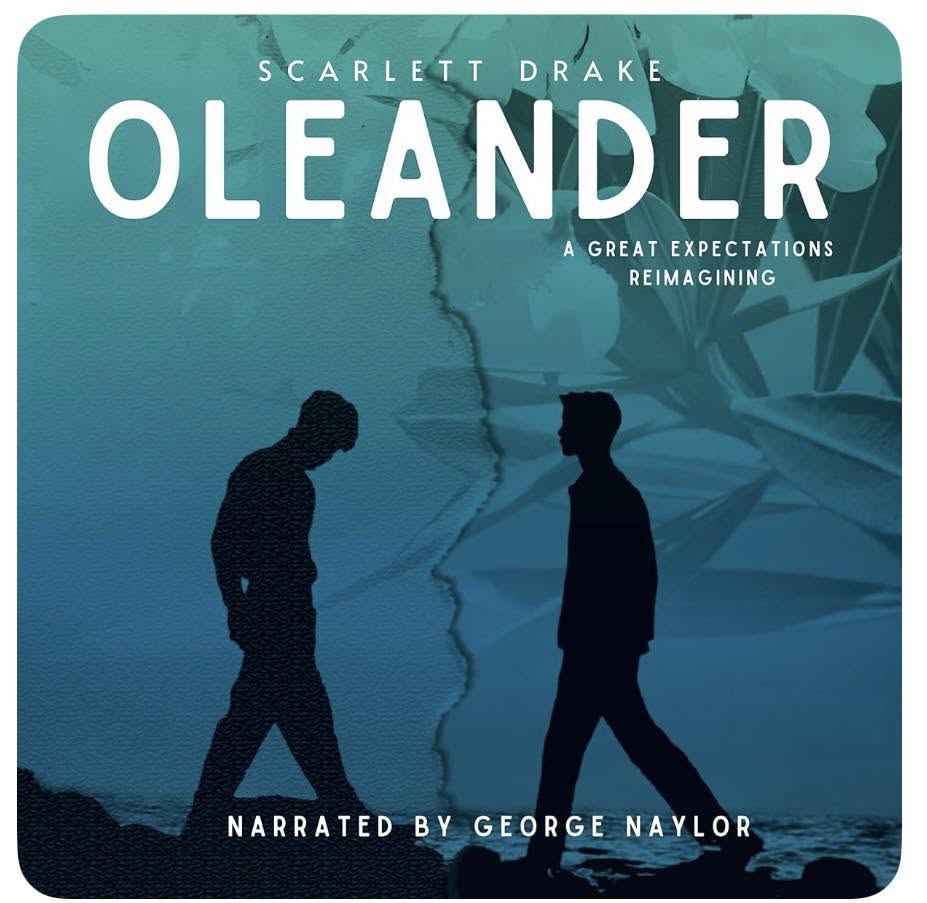
Oleander by Scarlett Drake
This book was such an unexpected pleasure.
It was written as a modern retelling of Great Expectations (Charles Dickens).
I am afraid I have to admit to having never read GE (or in fact any Dickens novels) so I can’t really tell you how well it did as an adaptation. But after finishing the book I read a Wikipedia summary, in the hopes of understanding it better.
I will say this, I think this book hits a lot of the plot points of the original, but I feel like the themes came out rather differently. But they really worked here.
Craft Wins
I loved the way the author caught the voice, and mindset of a teenage boy. You could see a distinct difference between adult Jude and the 15 year old version.
She draws nuanced and complex characters without relying on narrative explanation. She lets the reader sit with the mystery of people, their actions, their motivations. There were many moments where I am sure readers hated Cass, but I found him fascinating and sympathetic.
The final chapter is written in Cass’ POV and it’s a brilliant move, the story absolutely needed that for it to close satisfactorily. In seeing his perspective and specifically that he has done the work within himself to be better, the relationship feels like it has a future.
The author uses a lot of references between past and future to create and maintain suspense. I will admit, in my imagination I was expecting much greater disaster and tragedy on the basis of these cryptic allusions. But I think that’s part of the story’s charm, giving the reader space to let their imagination go a bit wild.
What is Love?
This a coming of age story, a gay awakening. It’s about abuse and neglect. About making things right. But for me mostly, this book was about what it means to love. And perhaps specifically, what healthy love looks like. It explores many different kinds of love, laying out contrasting examples. Romantic love, family love, sexual love. And it offers the reader the opportunity to assess what they consider best or healthiest.
I loved the exploration of family love, the anger and hurt Jude’s sister feels at not having as close a relationships with him as her husband does, while not seeing that it’s her own shortcomings that lead to that. It really resonated with me.
I think, for me, the story really asked the question: what is healthy unconditional love. I have long believed that a person who wants unconditional love needs to get a dog. That is the only creature capable of feeling or expressing that. Humans categorically are not. And honestly, they shouldn’t be. Unconditional love is too often love without boundaries. And in this story it certainly starts that way. But I love how Jude does develop boundaries. He does learn to draw a line with what he will tolerate from Cass. And boundaries within himself, what the repercussions of his actions will be given Cass’ shortcomings. He doesn’t love the warts, he loves in spite of them. He doesn’t look to change them, merely accepts what he can have. Because, sometimes you have to make the decision whether to to take what a person is willing to give you or to walk away completely. Because they will never love you the way you do them, nor give you more than they already have. And yet, that unconditional love is what saves Cass in the end, not because it’s there for him to abuse, but because he can hold the memory of love, of many different kinds of love from Jude close.
I loved Jude’s efforts to love Nathan, the recognition that this should be a relationship to hold onto, that it has all the markers of a good one. But being unable to commit to it. But what I loved is in juxtaposing Jude and Nathan, with Jude and Cass, we see that it would have never worked out. The power dynamic, the role Jude was holding within the relationship with Nathan would never have satisfied. That, as much as trauma, was what undid the relationship. Nathan saw a boy to be protected, but that was not what Jude was growing into. This relationship also showed us a more sympathetic view into how Cass might become involved with Xavier.
Poison and Growing
I did struggle to understand the main theme, which is in the name: Oleander, poison. The story is full of reference to poison, to growing inside and uprooted from inside and I can see it’s important but I don’t really get it. Cass is poisonous, he’s been trained to be so. Perhaps it comes down to the scene early on in the book where they find Oleander growing in the arboretum. I spend a large part of the story half expecting to learn Gideon has poisoned either Cass’ mother or father with it. But now I wonder if it was foreshadowing. That Cass was poisonous, but as a defensive posture. That he could unlearn that behaviour, uproot it from his life. But that the uprooting leaves a deep scar that takes a long time to heal.
Actually on re-reading this book I think I may be looking at this too literally (like usual) and focusing too much on the poison aspects. I think the theme here is more generally plants and growing things, roots and conditions of growth and the ability to repair if conditions improve. The nurturing aspects of plants. The way they hold us up even as we give them no regard.
It’s an excellent book. Everybody who enjoys queer romance with bite and seriousness in it should read this.