
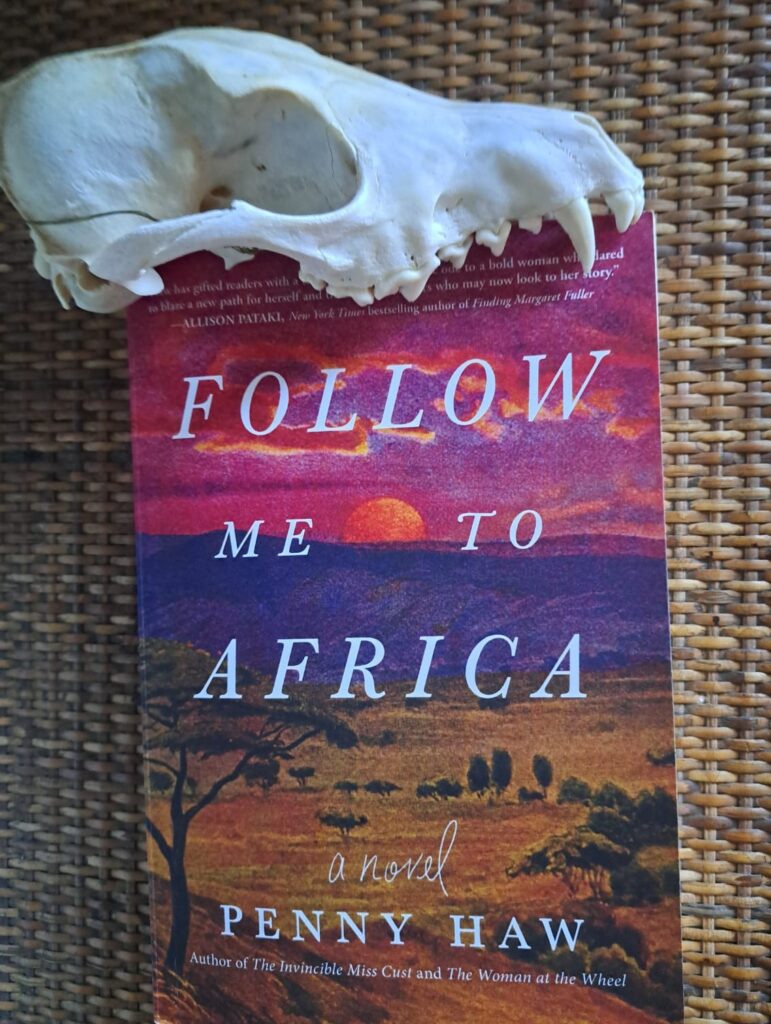
Follow me to Africa by Penny Haw
Readers might remember me waxing lyrical about the Kingsmead Book Fair a while ago. Well, here finally is my take on the one novel I purchased while there.
Fictional Biography
I attended a talk about writing historical fiction and blow me away if the second author didn’t introduce her book as being a fictional biography of the renown palaeoanthropologist Mary Leakey. Ding, ding, ding.
The Leakeys are among the most famous people in palaeo, and I have been hearing about them since I was an undergrad. My excitement (and astonishment – what were the chances?) was uncontainable.
So firstly, I should note that what the session was actually about was writing fictional biographies. Which, if like me, you had never heard of such a thing, refers to made-up stories about the life of a real and (importantly deceased) historical figure.
I love that this is a thing, because non-fiction pours out my brain like water, I cant ever hold any of the information, but tell me the same facts as a story and I will remember it on my death bed.
Fictional biographies, the authors told us, are a chance for a novelist to look in the spaces between the facts for the feelings and experiences of those famous people.
And after listening to that talk I had to have a copy of the Mary Leakey book.
Help, I cant find the fossils
The book really centred around the idea of what a older Mary might have wanted to tell a younger woman, what advise she might have wanted to impart given the life she had led.
You see, Mary came into a deeply male dominated world (in fact it has arguably remained so until very, very recently), and into an academic one, having had no formal schooling. None-the-less she made a fabulous success of her career, and become known for her rigorous scientific work.
The author took an interesting direction with the story structure, employing a dual narrative and two protagonists. Parts of the book are written in Mary’s perspective and in the past – focussing on how she became an archaeologist (including meeting her husband) and how she came to Africa (hence the title), and the effect that experience had on her. The other is set in the 1980s, with a fictional teenager Grace, who meets Mary right at the end of her career as she is packing up the field lab at Olduvai for the last time.
I enjoyed Grace and her arc and where the story leaves her, less so Mary.
The book was problematic for me for two reasons. One is that as a archaeologist what I was really interested in was Mary’s experiences as a palaeoanthropologist, but apart from a quick brush over some of the biggest finds and events, this books skips the main body of Mary’s career. I would have liked to explore that more and her experiences as a woman scientist. It’s one of those strange things about this field, it’s nearly impossible to get this older generation of women to talk candidly about their trail-blazing experiences, they always brush it off, like it’s bad sportsmanship to admit how shitty things were.
So I can’t really blame the author for not being able to convey that, it’s arguably a problem with my expectations, not her story. I think this is also part of the reason I struggled to connect emotionally with Mary. A lot of the really hard stuff was given little page time, so it just didn’t have the emotional hits for me.
There were also times when the narrative voice was a bit jarring. Like where it seemed to be in attached third but would suddenly bounce into the omnipotent narrator (from she thought, felt, to the girl did…). I don’t know if it was jumping or if I just assumed an attached perspective ‘cos that is what I’m used to, but those moments gave me a start each time.
So an enjoyable book, especially for the relationship that develops between Mary and Grace and for Grace’s arc from angry, hurt teen to young woman ready to take ownership of her life. But not one I would necessarily recommend to my friends in archaeology, at least not without a bunch of caveats.
Still I’m really glad someone took on Mary’s story, and that I had the opportunity to read it.