
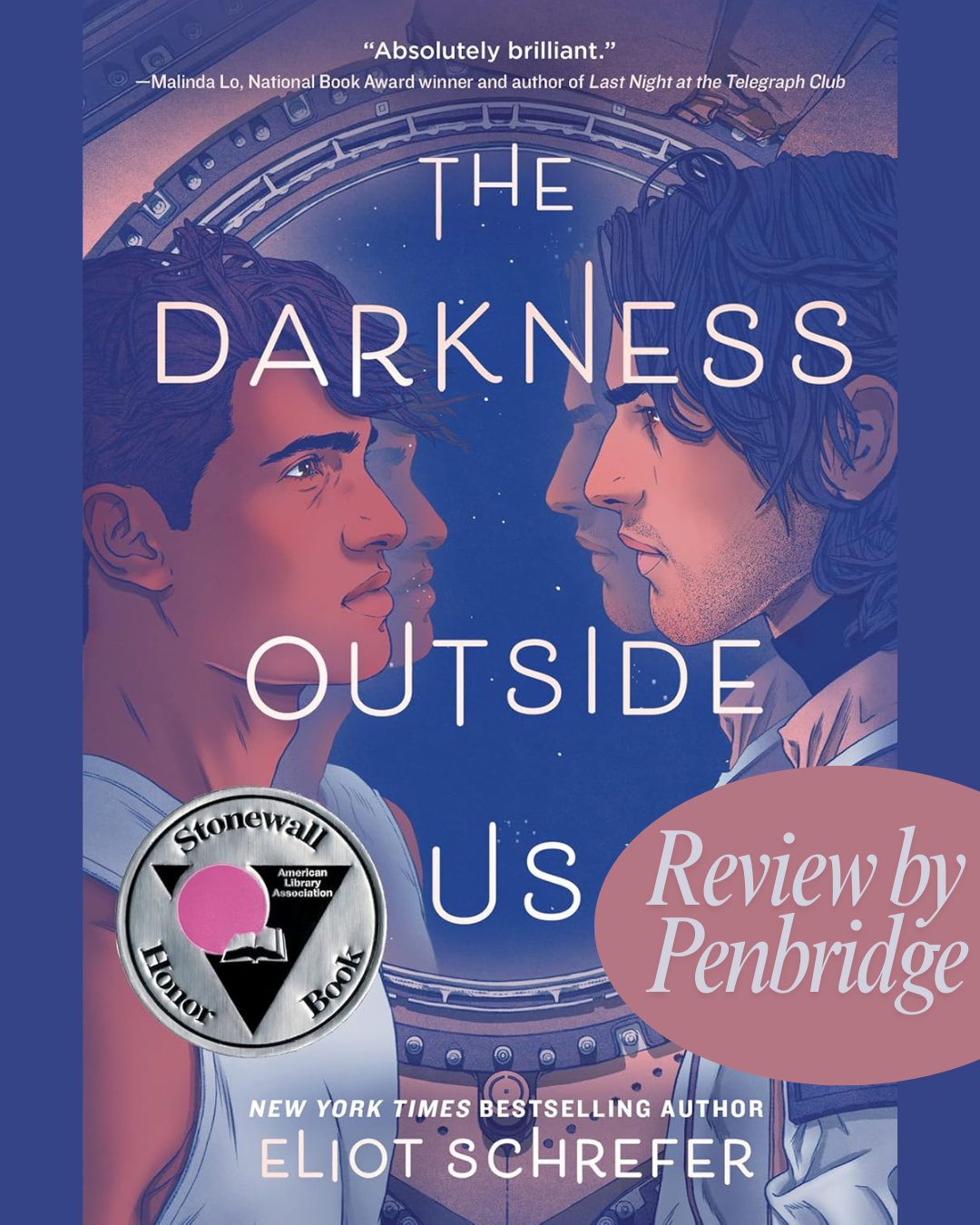
The Darkness Outside Us by Eliot Schrefer
What the Fuck even was this book?
I mean it was such an interesting idea, how two people might react in such helpless and unfair circumstances and how they might take back their agency.
But then that ending.
Okay there is some big stuff to unpick here.
For me, the biggest problem with this book is that it doesn’t follow-up on the promises it makes to its readers at the start. It sets up a bunch of expectations for the story both structurally and thematically, and then rolls all of them back to NO PURPOSE.
Structurally Wobbly
Let’s look at the structure first. This book starts with a strong mystery: What is actually happening on this ship? What do all the little anomalies in the spaceship mean and where do they come from? Who are Ambrose and Kodiac and why are they having these strange experiences?
But then it solves the entire mystery, in a single chapter, before we are even halfway through. Okay?
But it kinda works because the story energy pivots into the desperate battle between Ambrose and Kodiac against OS which gives the story some really driving action and lays down some really interesting themes (which we will talk on in more detail in a min).
All the while the romance is playing out beautifully.
But then the book solves the battle by having our protagonists remove the clones, thus removing the power OS has over them (in the sense of it having any reason to move against them).
Okay but we still have a goodly portion of this sucker left to go?
And at this point the book takes a frankly bizarre tonal shift and just whimpers itself to death. The next couple chapters are a saccharine ode to what a happy marriage looks like. Even pink-cover romance books understand this is meant to occupy a few pages of epilogue.
Example: When the last Ambrose is awakened the message left to him (by his predecessor) is a long soliloquy about love. I can not tell you how much this irritated me. Past Ambrose knows that he wouldn’t believe any of it. And that he would have more important things to worry about just then (like being lied to, like his sister actually being dead, like he’s one of the last humans alive, like he’s about to land on a strange planet). This dropped me out of this world like a brick through a window – it was so objectively stupid.
I expected the slow breadcrumbing of a interesting mystery, and got the answer handed to me. I expected a driving battle between two boys and an all-powerful, unemotional AI, and got a premature climax (pun intended). And then all the emotional energy was left to dissipate unresolved by the strange tonal shift. Do you see why I was unsatisfied?
Perhaps this strange structure could have been rescued if it had meant something thematically, but even in that the story fails.
Thematically Lost
I mean, what was the story here?
It screamed themes of autonomy over fate. It questioned whether the needs of the hypothetical many should outweigh those of the few. It showed that every person – even where society might consider them disposable – deserves the opportunity to live.
But what jumped out at me, what seemed to be the whole point of the book, was a subversion of the man the empire builder notion.
Think about it. The extraordinary expense of making this spaceship and stocking it, growing dozens of clones, the fact that nobody involved would live to find out if it worked, that humanity itself was unlikely to remember (and pretty much didn’t) that this vessel had been sent out. All to preserve a species that wasn’t (yet) on the brink of extinction.
And set that against our two protagonists who choose to potentially destroy the mission, leaving only a single slim thread to hang its success on, so they can have a life together. They were destined to rebuild humanity and instead they choose their own fate over that of their species. Like that’s some powerful stuff.
But then the last couple chapters suddenly dive into left field and just abandon those principles.
Okay this is where it gets personal, so let me explain, because the other big thing that scraped my nerves raw was the whole reproduction detail crammed in at the end.
The thing is, I HATE happy family stories – I find it sickeningly heteronormative. And yes, I know the arguments about reclaiming nuclear families for queer spaces – but the thing is when you are female, having children isn’t a liberation of gender norms, its the fucking ball-and-chain (I should note that not all queer woman feel this way).
I can’t wrap my head around the idea that Ambrose and Kodiak would look at this very dangerous and uncertain life and say, yes, lets bring babies into this. That they would curse those future humans to an incredibly difficult and lonely existence. Maybe I should, humans are capable of profound selfishness, but I don’t want to.
But my anger is deeper than that because in making this choice there is an underlying implication that ultimately Ambrose and Kodiak support the mission objective – namely rebuilding the human race. That these two men, who had been treated like used food containers, who had killed their own clones for a chance at a measly 20 years of life together (actually when I put it like that maybe it makes perfect sense) plumbed for human survival. It was deeply off-putting.
You don’t need babies to justify your existence in this world.
Humanity existed and was successful (for whatever subjective definition of that world you choice to employ) whether it survives into the future or not.
Also the scientist in me needs to point out that this is a genetic bottleneck, inbreeding occurs at much less extreme levels than this and there are inherent paternity issues for the next generation that are unpleasant to think about (although no doubt mission control arranged a solution for this – but yuck, thanks for making me wonder about that).
And to circle back to the themes, what then was the story here?
You can’t subvert empire building if you end with the rebuilding of the species.
It isn’t love or personal autonomy over the demands of others when the main sacrifice doesn’t change the outcome of the story.
So, I ask again, what was the story here?
Collapsed Stars
I mean I get it, readers would not have been happy with ending the story after the clones are destroyed – the mission needed an ending. But it should have been a matter of tying up loose ends or a hanging, implied ending like a short story.
The story arc collapses in the arms of this ending.
I will say in the book’s favour that I found the writing style really engaging. The close attachment to Ambrose’s perspective really drove the mystery which I loved. But once the mystery was solved then I didn’t have so much energy driving my engagement in the story.
And the romance worked. I loved the idea that they were kinda fated to keep falling in love, every iteration, that tickled the romantic in me.
And the use of the little vignettes or small details was a really genius way to reflect the repetitive and cyclical nature of the story.
I don’t know, the metaphorical usually goes over my head, maybe that is what happened here. But to me this book doesn’t know what story it was trying to tell and thus only succeeds in half-telling far too many.
Definitely not worth the hype.