
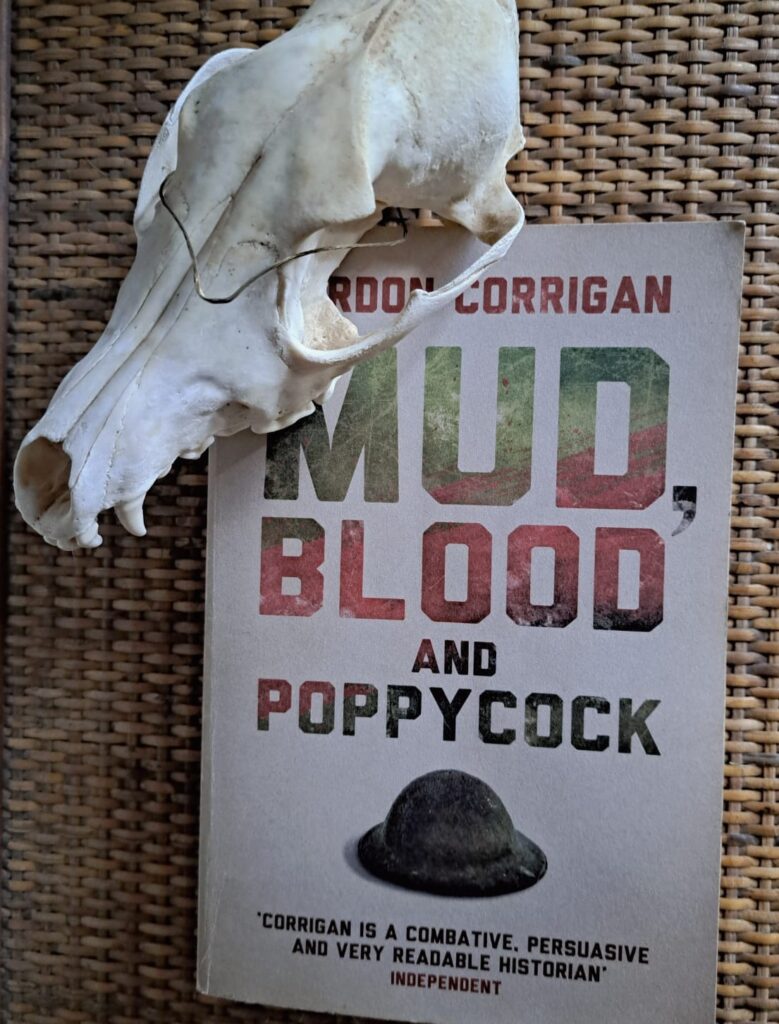
Mud, Blood and Poppycock by Gordon Corrigan
This will overturn everything you thought you knew about the first world war
It is an interesting premise: that our perspective of WWI as unnecessary and a waste of men is all a lie.
In this book Corrigan chips away at numerous misconceptions about the war by examining and recontextualising them. He makes a compelling argument in each case that the stories we have been taught about the war in no way reflect the reality, or the perceptions of those who were there at the time.
Corrigan brings his expertise as a retired officer of the Royal Gurkha Rifles and a historian. Which is to say he’s British and an ex-soldier, and the book definitely reflects that, but he is honest enough to acknowledge it.
Modern sensibilities
He starts by providing an explanation for how we came to this ‘warped view’ of the Great War. In the immediate aftermath of the war (1920’s) the majority opinion was that it had been a “just a war”, that it had been necessary, and that Britain had done her bit to win it.
However, sentiment began to shift in the 1930’s, especially after the publication of All Quiet on the Western Front by Erich Maria Remarque, which critiqued the war and the conditions soldiers experienced. Following this there was a deluge of anti-war writings, by many influential writers. But it’s important to remember that this was happening in a context of a growing rise of pacifism in the interwar period. Soldiers who had enjoyed their war or were overall in favour of it (and were foolish enough to say so publicly) were ignored or heavily criticised. Further, the 1960’s saw another flair-up of anti-war, anti-establishment fervour, and consequent critiquing of the Great War by leading historical scholars, who perhaps also had an axe to grind.
In this work Corrigan challenges those writings and the ideas we hold about WWI today by investigating the war from the perspective of how armies work, how battles are conducted, what equipment and tactics were available at the time, and what the objectives were relative to the political situation. Chapter by chapter he takes up the major lies of the war and I cant resist giving you an abridged version of what I learned from this book, although I encourage everyone to read it themselves as the details really do make the story.
Poppycock Time
The Great War was unnecessary
In answer to this he provides the singularly most cogent explanation for why the war happened that I have ever heard. Recontextualising European geopolitics rather than looking at isolated events like the Arch-Duke.
The war resulted in a Lost Generation
Casualty numbers say otherwise – this wasn’t even the most deadly conflict Europe has engaged in. But there was a problem with forming battalions based on geographic proximity at sign-up, since what happens to one man in a battalion has a high likelihood of happening to the entire group.
The horrors of the trenches
Corrigan provides detailed accounts of how life was conducted in the trenches, from design and construction, to daily life; with an emphasis on how little time British soldiers spend on the front line in any one stretch. The French were not so considerate to their men.
He also supplies a treatise on the weather.
Terrible Weapons
It is true that technology lunged ahead over the course of the war and that the all armies struggled to keep with up these changes. The section about the first tanks was fascinating. But it is also worth remembering that there was next to nothing available at the start of the war. Hell, the American army’s artillery was described as obsolete when she began raising a force to serve in Europe.
Gas warfare was a terrible evil
But probably not as effective as we have been led to believe. Casualty numbers from gas are low compared to other causes of death, and many injuries (like blindness) were usually temporary – not that it was any less terrifying for those soldiers. Further it was extremely difficult to use gas effectively, as it is rather weather (wind) dependent. Corrigan does acknowledge, in a typically british way, that in fact Britain was usually ahead of the Germans in chemical warfare development, but very good at waiting for the Germans to up-the-ante in some way, allowing them to claim their usage was retaliation.
The progressive development of gas masks is also fascinating, especially how quickly this technology was developed and deployed.
Useless officers
Aka officers who hid behind a desk while they sent men over-the-top to die. People of a certain age will remember this detail well from the Blackadder show. Corrigan takes the reader through the process of becoming an officer in the British army with a focus on how the army had to go from a very small career institution to a massive volunteer one, and how there just weren’t enough officers to go around. He shows extensive evidence for how invested British officers were in their men, although this was another place where the French showed poorly by comparison.
He then goes on to investigate the very top brass and their relationships to the political structures back home, and wow it was a serious toxic-workplace situation.
Death by firing squad
The chapter starts with a arguably defensive explanation of military discipline with a focus on why it needs to be so strict, before digging down into the records to show that executions or even dishonourable discharges were almost never handed out for the reasons we tend to think of. In fact, most discipline issues related to offenses committed under the influence (of alcohol) because apparently soldiers never change.
Corrigan also spends some time investigating what shell-shock is, as we understand it today, and as they did then. And the TLDR is that it was always understood to be a mental health problem and was treated as such. They didn’t shoot men for it – they send them home.
Needless slaughter and more needless slaughter
There are two whole chapters devoted to the battle of the Somme.
Corrigan places the battle within the political context, that this was an allied effort and the French had to be kept happy, even where plans ran contrary to the advice of British officers.
He does acknowledge that the British army made some catastrophic mistakes in the first days, but it was worth remembering that the setting was new and the vest majority of the men on the ground were brand new, under-trained and there were far too few experienced officers to lead them. Catastrophe, he implied, was to be expected and the army learned from its mistakes quickly, the later parts of the battle were no where near as deadly. The Somme, Corrigan concludes, was neither needless nor a slaughter.
Also, another treatise on the weather – basically it was, barring a few exceptional days, one of the driest on record for that area.
And Even more needless slaughter
Was Passchendaele a waste? Corrigan argues that it was absolutely necessary that the British commit to a big offensive at this time to stop the Germans over running the allies, all because of the mutiny of the French army.
In fact most of the chapter is devoted to discussions on what happened with the French and its implications for the war overall – the author even apologises for wasting so much of the reader’s time on the French (which is just the most British response ever). The French army mutinied over pay and leave (since many were often stuck on the front lines for long periods and were thus emotionally exhausted), and it was mostly peaceful demonstrations and refusals to follow orders. But this was the army so that is pretty serious. The state of the French army had to be kept extremely secret and the Germans had to be kept engaged elsewhere because had they found out that the British were basically out there alone…
It took a long time for the French to get their shit together and their army was never really quite the same afterwards. But fortunately by then America had gotten off her arse.
Here comes the Cavalry
Without a doubt my favourite chapter in the whole book considers America’s role in WWI. The author describes common sentiment in Europe and Britain (today) as:
America wanted nothing to do with European squabbles, they entered the war at the last minute, contributed nothing, and were the only power to make money out of it.
And even after reading this book I’m inclined to say that is still an accurate summation, although Corrigan uses the context to show why America acted the way she did.
First it is important to understand how aggressively the American populace did not want their country getting involved in a war that, to most of them, seemed very far away. Getting involved was not considered an expedient move by American politicians. But those politicians were not blind to the potential implications for the war and were very happy to help behind the scenes by supplying Britain and Europe. Which was also a win-win for them because they made sure to charge the allies for the assistance – hence America walked away the only financial winner of the debacle. Although, it is worth noting that America was already poised to begin her assent into a world power before the conflict.
We should also note that at the outbreak of the war the American army was virtually non-existent (remember the obsolete artillery?). Further, Germany very much did NOT want America getting involved. So they used Agent Provocateurs to stir up trouble on the Mexican border to keep them busy. In fact, an intercepted message to these agents was what turned the tide for America. Once committed, she mobilised with staggering speed, but then politics and American pride got in the way as they would not commit to Europe until they had a full army. The threat of their arrival had been the Sword of Damocles over the German heads and once it fell so too did the Germans, quickly, so the American army barely had time to do anything.
America might like to think she was the deciding factor, and her potential arrival affected a lot of decisions in the latter part of the war. But Corrigan attributes the fall of Germany more to the effectiveness of Britain’s naval blockade which had been very effective at starving Germany out.
Persuasive Arguments
The book closes out by looking at the aftermath of the war in relation to WWII – Corrigan describes the two world wars as two halves of the same conflict, which really resonated with me, as I have enormous trouble keeping them separate in my mind.
Corrigan’s book was fascinating, if a little too detailed at times – like I’m never going to remember which divisions fought which parts of the Somme. But I always enjoy weaving new history knowledge in with what I thought I knew – which was what this book was really about, placing the conflict into its context.
Corrigan’s arguments are persuasive, but I still find it hard to conceptualise his viewpoint of the war as overall a positive and necessary event compared to how we have been raised to view it. The other narrative is just too strong in our culture. Still it was really interesting and well worth the read. Now I need to find a new non-fiction.