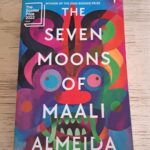
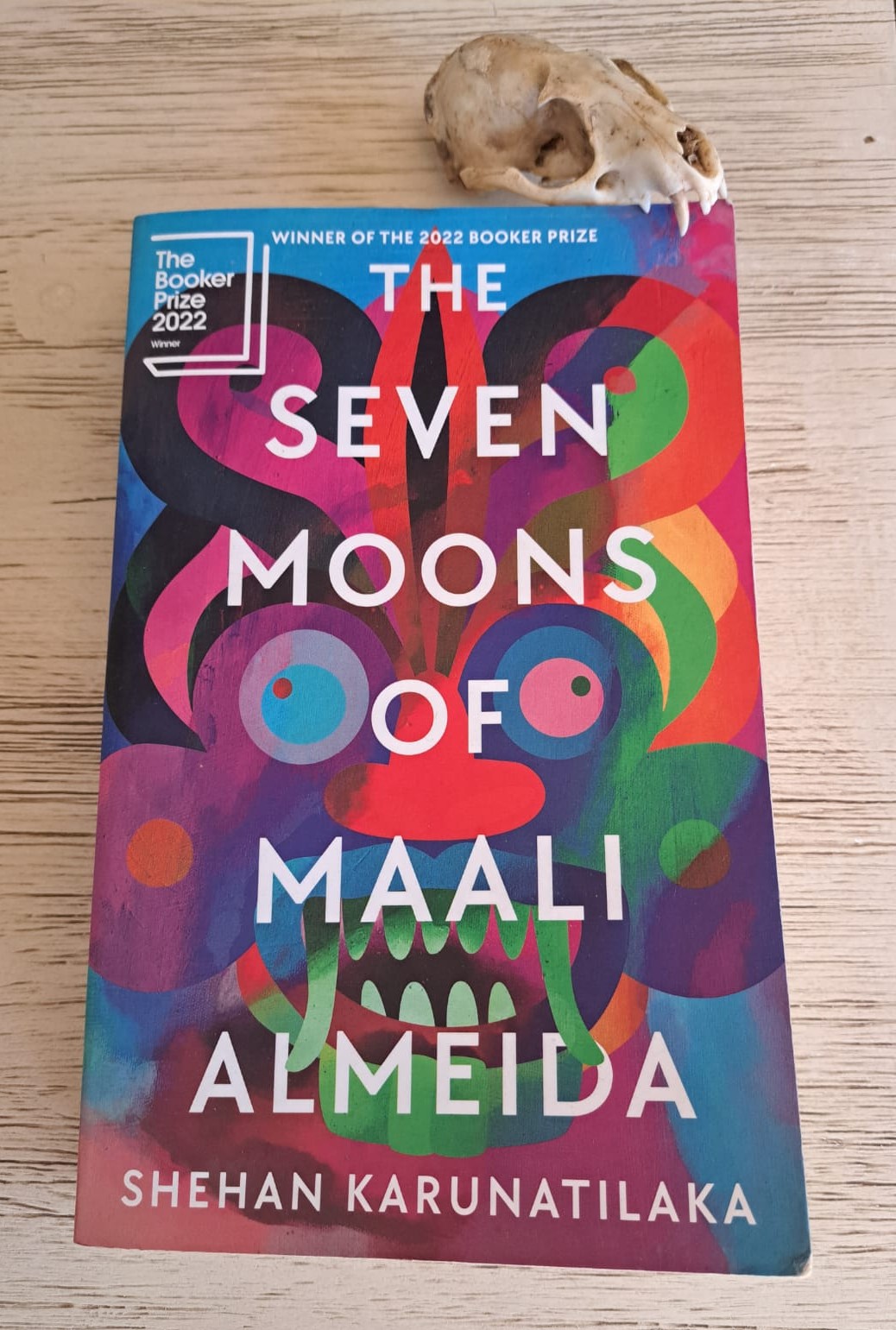
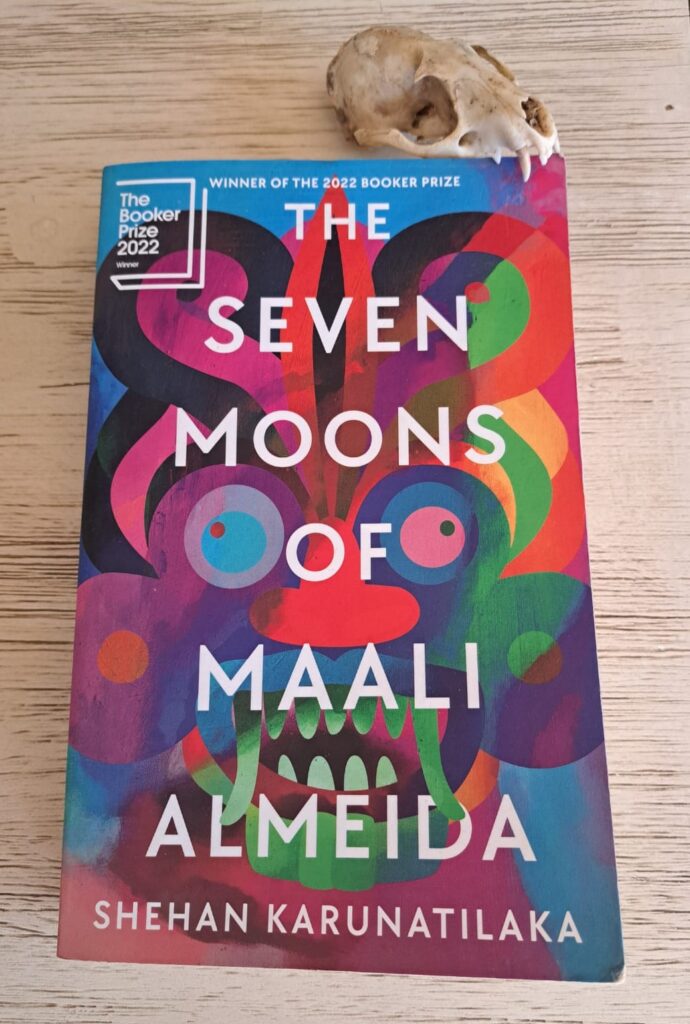
The Seven Moons of Maali Almeida by Shehan Karunatilaka
This book is a fascinating read and really cleverly done.
Turning Perspective on its Head
The first thing that hits you is the POV – second person.
The entire book is written that way and the mind boggling thing is, it works. I think the reason it works is in the nature of the story. In the second person voice we get the perspective of a narrator, an outside observer. But in this case, he is observing, and commentating on, his own life. It is, in effect, that little voice in the back of your head that makes sarcastic remarks. The one that goes well that was a stupid thing to say, when you find yourself suddenly the instigator of an awkward silence. Who provides endless iterations of better ways to handle situations, long after the opportunity has passed. It’s a narrator wearing the veil of objectivity, while actually being incredibly biased and unreliable.
Complex Characters
A friend – we read this together in our writing group, because we are now apparently also a book club – found Maali as a character very off-putting. But I find myself wondering to what extent he was responding to Maali’s own self-loathing as expressed by the second person POV. Look at it like this, he consistently described himself as a slut. He talks about his endless infidelities, and of sex with cold indifference. They are a stick he beats himself with. But at no point does he engage with any concept that there might be underlying drivers for his behaviour. He never engages with the idea that perhaps his addiction may not be limited just to gambling. Or that it could be linked to a lifetime of trauma – a neglectful childhood, internalised homophobia, violent systematic social homophobia, sexual harassment, war journalism. Hell when you list it out like that its astonishing he was functional at all.
Look at the way he talks about the abuse by DD:
Sometimes you deserved it.
Did you Maali? Did you really? Or was it easier to seek punishment that risk disappointment?
Homophobia and Relationships
I found the way Maali described DD interesting:
The perfect 10 out of 13
The first time, I thought it was a literary devise Maali was using to make light of how much he loved DD. But its repetition makes me wonder. The poignancy of considering a man who hits you, as still being the perfect man.
And the physical abuse isn’t the only bad way DD behaves. There are attempts at emotional manipulation, a blindness to his father’s behaviour, and perhaps infidelity on his own side given how quickly he is partnered at the end. And yes we have to acknowledge that loving Maali could not have been easy. But this wasn’t healthy either. And yet the author clearly shows the ways in which this behaviour is understandable, given the homophobia and violence that surrounds them.
He juxtaposes this relationship against Jaki, who knew and understood Maali better than DD did. You feel Maali’s pain so viscerally in his account of how difficult it was to talk to his loved ones about his work. Of returning from a war and feeling that the person he could tell wasn’t listening, while the one who would listen he couldn’t tell it to. Sometimes it seemed to me that DD wasn’t really seeing Maali, but rather an idea of him in his head.
On a personal level, I also really enjoyed the perspective we got into Maali’s relationship with his mother. Her inability to see his emotional needs really resonated with me. And I find it so fascinating how, in many ways, Maali was invisible to her as a boy or person. And yet she is devastated by his loss. So much so as to be moved to political action after his death. It’s a subject matter I have been grappling a lot with recently. The contradictions people hold within themselves. How parents can love their children fiercely, but also be completely blind to them as people.
People not politics
I really enjoyed the clever way the author drip-fed the different elements of Maali’s history into the story, so as to force you to reconsider your assumptions. Nothing in this book is what it seems at first.
But I think there is also something to be said that, despite the politically charged atmosphere, despite Maali being in possession of dangerous knowledge, none of this is what kills him. I think it’s taking the idea of powerful outside forces and breaking them down. Maali isn’t killed for politics, he’s killed by a jealous and possessive father. In effect for being homosexual with the wrong boy. Likewise, when the pictures are exhibited the response is anti-climatic to say the least.
This isn’t really a story about politics, it’s a story about people.
Even the evil-doers (like the torturer) are broken down into humans. The author goes to great length to show how thin the line between good and evil is. And how easily a person can create a logic progression that makes lives into tradeable commodities.
Reflection versus of Redemption
I also really enjoyed this view on the afterlife. That opening line:
Just like here but worse.
That the afterlife isn’t a special place. But more than that, I feel like its another comment on humanity. Like, because it exists for and is populated by people, so it reflects the world we know and are familiar with. It can’t be better because it is people, flawed and obtuse, who make it. Because ultimately all the things that are wrong with the world are made by those inhabiting it.
In some ways it’s a challenge to the Judo-Christian images of the afterlife as a place for judgement, be that salvation or damnation. Your opinion of your life is irrelevant, you are irrelevant, compared to God. This story offers a very different idea.
The seven moons are Maali’s period of post-death reflection. While he spends them having an adventure, the story is much more concerned with understanding his life, his decisions, and the effects it had on other people. And I think that is what makes it so beautiful, is that it is the opportunity to come to terms with life, after it has happened. Not external judgement from a higher being. Just the opportunity to decide for yourself on both your actions and your future.
It is redemption without the trumpets. Maali isn’t a changed man at the end, he’s not fixed. But he’s more aware. I really liked that about the story. It felt very real.
Complex Worldbuilding
The story, in its richness and detail of the Sri-Lankan civil war is, of course, a scathing political commentary. But I also know a lot of readers struggled with the lack of explanation in this book. It is a constantly bewildering array of different terms and peoples and interconnections that don’t make sense to an outsider.
But for me it wasn’t necessary to make sense of it. It was there for the immersive detail of the story. Maybe that’s just the way I like reading, to float along on the tide of the story, without having to keep stopping for research. And I feel like this book struck a good balance of rich detail and complexity, that builds the world and the character but doesn’t leave the reader completely lost. Others grew frustrated with it.
This isn’t a book about the afterlife. Or about the Sri-Lankan civil war, or even about politics. It is a book about people and their complexities. What they do and what effect it has on others.
As a rule, I don’t read literary prize winners, but this is an incredible book, and I feel richer for having read it. Although I will recommend with caution, it’s not an easy read.
PS. Lol, always beware of a literary fiction books with a cartoonish cover. If it looks like a candy shop on the outside then you are in for some dark stuff on the inside.