
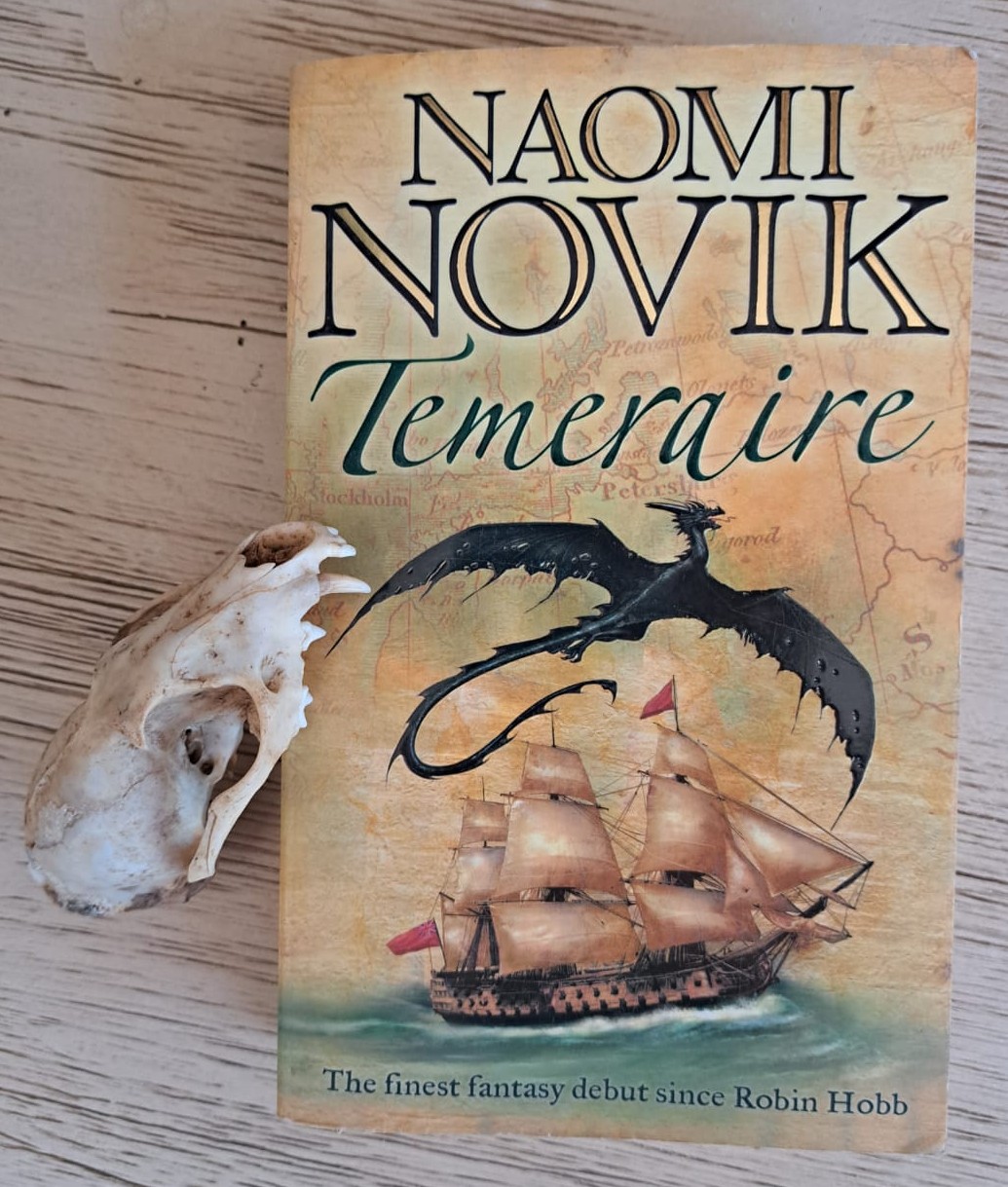
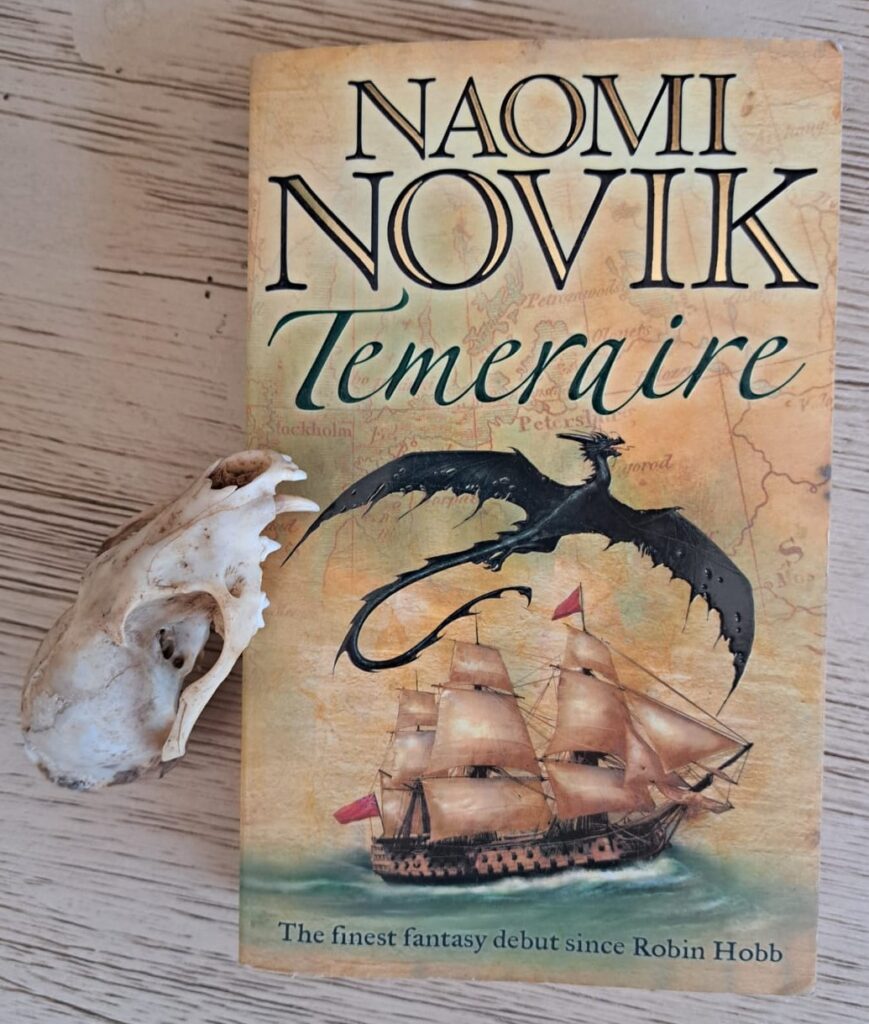
Temeraire by Noami Novik
Book one of His Magesty’s Dragons Series
I love this book.
Returning
Okay confession time, I actually read this book, must be 10 years ago. I loved the first book, less so the others, and I stopped at the fifth book, when the series started feeling more like a world tour than a coherent narrative. Looking on it now, I wonder if Novik’s intention was to break away from the Euro-centric view of fantasy most of the genre falls into.
As readers of this blog will know, I have been indulging in more of Novik’s work (Spinning Silver, Uprooted) in recent years. I had made a resolution that I wanted to get copies of her books, Temeraire included.
So how is my luck. I’m busy buying a second-hand copy of a story I need for book club online. Having found what I needed I decided to scroll around (as you do) and when I searched for Novik what should pop up but a copy of Temeraire. I place a bid on it, concluded my order and got the hell out of there before I really got carried away. Only to find I had won the bid, getting a beautiful copy for a ridiculous price (I literally spent more on shipping). So now here I am reading it again (and again, and again) and wanting to dive back into the whole damn series.
The Writing
Coming back to this book also gives me an opportunity to examine it from a more mature perspective that I had the last time. I still love all the same things about the book, just now I appreciate how Novik induced those feelings much better.
Lawrence’s voice is one of the things I have always loved the most about this book. She has an astonishing skill for imbuing voice in her characters. With this book you get the stilted, formal language of a bygone age that gives the story amazing authenticity.
I’m not quite sure what you would call her POV, she sticks tightly to her protagonist, so you see the story and goings on strictly from his perspective, but steps away enough to describe him at times. Not that it detracts from the story, just an observation. Or maybe this just reflects that this was her debut novel?
I love the way the big reveal was setup multiple times earlier in the book, from the way Temeraire learns to roar from the first big dragon he meets, to Laurence a few times describing his ears as hurting from very loud roars, always the reader is led to believe its the volume alone that is having that effect.
But then there are a lot of other set-ups that don’t pay off. The private development of flying techniques based on Temeraire’s unique skills, for example, doesn’t lead to anything. And a lot of characters who get introduced but don’t come back into the story. But again, I don’t feel like it detracts from the story.
The World
And this world. It’s like Deadly Education. She took the premise and what-if’ed it to the nth degree. The idea of dragons as basically a ship in the air, with a crew and a army division, and tactical manoeuvres, and ranks. Just such a brilliant idea. And then to place it within the context of the Napoleonic wars – like why? Where the hell did she get such a brilliant idea? I want her brain.
Ten years ago I barely knew what the French Revolution or the Napoleonic wars were (for some reason this is not a major learning goal in schools in the arse-end of Africa). Now I have a much better understanding of the context to colour the story. I feel like it captures it’s time context beautifully even as it’s all make believe.
This story takes all the qualities we have come to love about dragon stories and looks at them with all with seriousness. What does it mean to love a dragon, are dragons all the same (in terms of temperament and intellect), do all humans love their dragons in the same way or to the same degree?
In a lot of ways I suppose the book is exploring the question of what love and duty mean to each other. How much will you sacrifice one for the sake of the other.
Background to the name
There really was a ship called the HMS Temeraire, known as the Fighting Temeraire for her role in the battle of Trafalgar. Specifically, during the battle she came to the rescue of the beleaguered Victory (Nelson’s flagship) and captured two French ships of the line in the process.
There is also a painting by Turner that shows the vessel being towed up the Thames on her way to being demolished. There is further a ballad on the same subject.
Many feel the Temeraire, as expressed in these artistic representations, reflects a nostalgia for a bygone era (in which steam had not yet replaced wind power). Which does rather feel like it could be a theme of the story, a nostalgia for a kind of fantasy story of the past. Isn’t the fantasy genre itself rooted in nostalgia?
But the word Termeraire is French, meaning reckless, rash, bold, or foolhardy. Which if you read accounts of the ship’s work at Trafalgar adds up. And again I think is a good description for both the dragon and his Captain (although both would vehemently deny it).
Temeraire is an exceptional fantasy story. With a fascinating premise, a beautifully built-out world, incredible voice and a driving plot, that is delivered in a concise and sharp package. Its brilliant and everyone should read it. Even if you never read the rest of the series.